
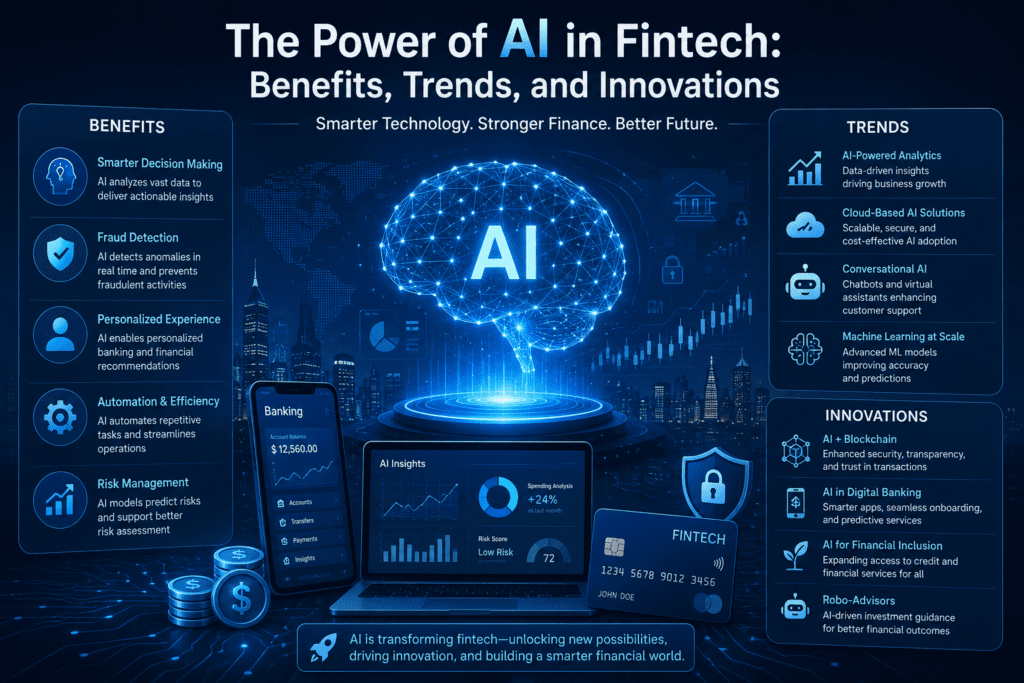
The financial services industry stands at an inflection point. Artificial intelligence has transitioned from a buzzword to a fundamental technology reshaping how institutions operate, serve customers, and manage risk. From robo-advisors to fraud detection algorithms, AI is quietly revolutionizing fintech, creating unprecedented efficiencies while simultaneously raising important questions about accessibility, security, and fairness.
The Fintech Revolution Powered by AI
The financial technology sector has always been early in adopting cutting-edge technology. But the rise of AI represents something different—not just a tool for automation, but a fundamental shift in decision-making and customer interaction. Today’s fintech companies leverage machine learning, natural language processing, and deep learning to solve problems that were previously unsolvable at scale.
The numbers tell a compelling story. According to industry reports, AI-powered fintech investments have grown exponentially, with global AI in fintech market valuations reaching tens of billions of dollars. More importantly, these aren’t just isolated experiments. From banking giants to ambitious startups, institutions worldwide are deploying AI across virtually every function within financial services.
What makes AI particularly powerful in fintech? Speed, precision, and scalability. Traditional financial processes often rely on manual review, human judgment, and rule-based systems that can be slow and inconsistent. AI systems can process vast amounts of data instantaneously, identify patterns humans might miss, and scale solutions across millions of customers without proportional increases in headcount.
Key Benefits: Why Fintech Companies Are All In on AI
Enhanced Fraud Detection and Prevention
Fraud costs the financial industry hundreds of billions annually. Traditional fraud detection systems rely on rules and historical patterns, making them vulnerable to novel attack vectors. AI-powered systems, by contrast, learn continuously from new data. Machine learning models can identify suspicious transactions in real-time by analyzing hundreds of behavioral signals simultaneously—spending patterns, geographic anomalies, device information, and temporal factors.
These systems don’t just catch fraud; they do so with remarkable accuracy. Advanced neural networks can distinguish between legitimate transactions and fraudulent ones with precision rates exceeding 99%, while minimizing false positives that frustrate legitimate customers.
Personalized Financial Services
AI enables fintech platforms to deliver highly personalized experiences at scale. Recommendation engines analyze customer preferences, financial goals, and behavior patterns to suggest products and services tailored to individual needs. Robo-advisors use AI to create and manage investment portfolios aligned with each customer’s risk tolerance, time horizon, and objectives—previously a service only affluent individuals could afford.
This democratization of financial advice represents a genuine shift in accessibility. Someone with modest savings can now access investment strategies that rival those of professional investors, optimized by algorithms that continuously adjust allocations based on market conditions.
Improved Credit Decisions
Traditional credit scoring relies heavily on credit histories and collateral, locking out millions without established financial records. AI models can assess creditworthiness by evaluating alternative data—income patterns, utility payments, rent history, educational background, and even behavioral indicators. This broader perspective enables lenders to serve previously underbanked populations while maintaining healthy default rates.
The impact is profound: individuals who would be denied traditional credit now access loans to start businesses, pay for education, or navigate financial hardships. For lenders, expanded addressable markets mean business growth alongside improved financial inclusion.
Operational Efficiency
Behind the scenes, AI drives dramatic cost savings. Intelligent automation handles routine tasks—document processing, customer service inquiries, account management—with minimal human intervention. Machine learning models optimize everything from workforce scheduling to infrastructure capacity planning.
A single AI system managing customer service inquiries can handle the equivalent work of dozens of human agents while maintaining higher satisfaction scores and faster resolution times. These efficiencies translate to lower operational costs, which increasingly competitive fintech markets push toward customer benefits through lower fees.
Current Trends Shaping Fintech’s AI Landscape
Generative AI and Large Language Models
The release of advanced large language models has opened new possibilities for fintech. AI-powered chatbots and virtual assistants can engage in sophisticated conversations, answering complex financial questions and guiding customers through processes. These systems don’t just provide generic responses; they’re being trained on financial data, regulations, and product knowledge to deliver contextually appropriate guidance.
Generative AI also accelerates internal processes. Research teams use it to summarize market reports, compliance teams leverage it for regulatory monitoring, and risk teams employ it for scenario analysis. The productivity multiplier effect is substantial.
Explainable AI (XAI)
A persistent challenge in AI adoption, particularly in regulated industries, is the “black box” problem. Why did the algorithm deny this loan application? What factors drove this investment recommendation? Regulators demand answers, and customers increasingly expect transparency.
Explainable AI addresses this through models and techniques that illuminate the decision-making process. Feature importance analysis, SHAP values, and interpretable machine learning models help stakeholders understand how AI systems reach conclusions. This isn’t just compliance theater—it builds trust, essential for widespread adoption.
Federated Learning and Privacy-Preserving Techniques
Financial institutions sit on goldmines of data, but privacy regulations and security concerns limit how freely this data can be shared and combined. Federated learning enables AI models to learn from distributed data without centralizing sensitive information. Rather than sending customer data to a central server, the algorithm travels to the data, learns locally, and returns only the insights.
This approach allows competing institutions to collaborate on improving shared AI capabilities—fraud detection networks, for instance—while maintaining strict data privacy. It’s a win-win for innovation and consumer protection.
AI-Driven Regulatory Compliance (RegTech)
Regulatory environments grow more complex annually. Machine learning models now monitor transactions in real-time for compliance violations, predict regulatory changes, and automate reporting requirements. These systems reduce the risk of costly violations while allowing compliance teams to focus on strategic concerns rather than manual monitoring.
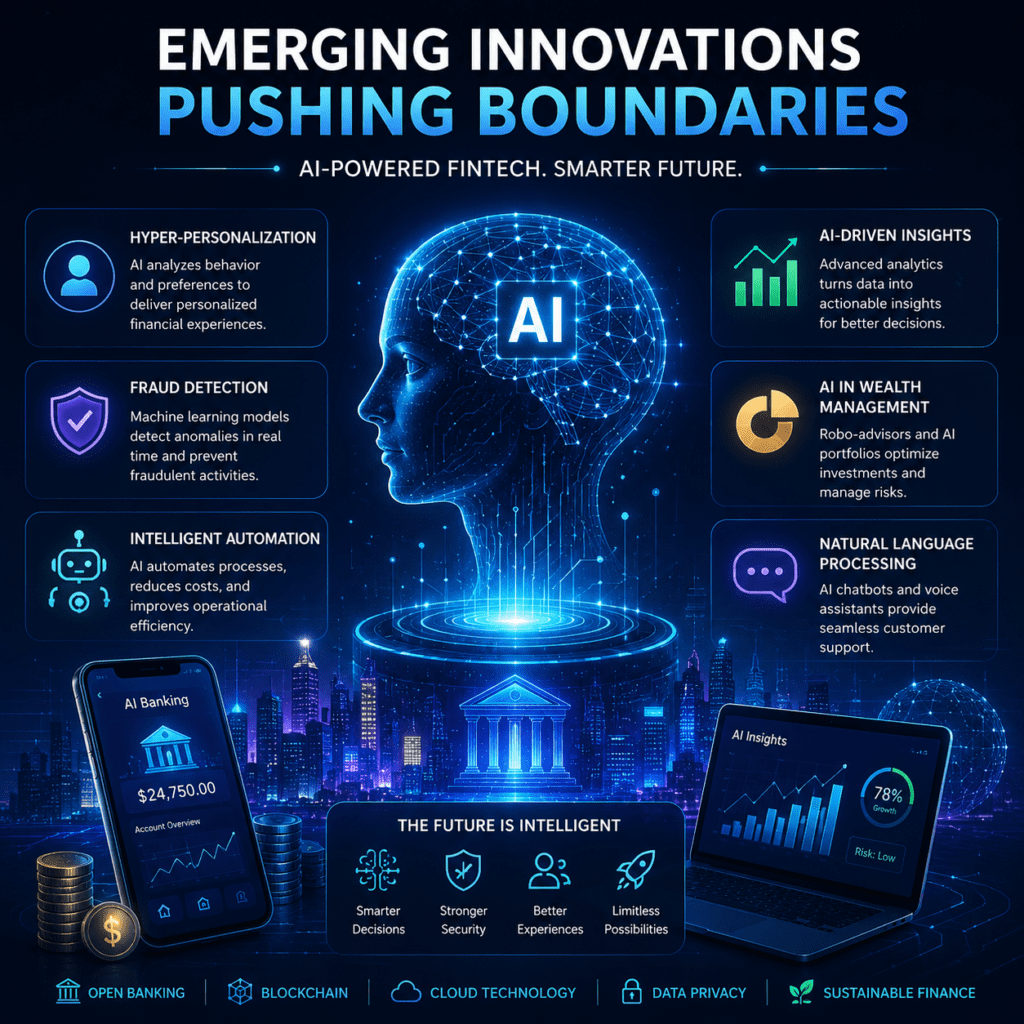
Emerging Innovations Pushing Boundaries
Decentralized Finance (DeFi) and AI
The intersection of AI and decentralized finance represents genuine innovation. AI systems are being deployed to predict smart contract vulnerabilities, assess cryptocurrency risk, optimize decentralized exchanges, and detect market manipulation across blockchain networks. As DeFi matures, AI becomes increasingly essential for risk management.
Predictive Analytics for Market Intelligence
Institutional investors have long used quantitative models, but modern AI takes this further. Advanced neural networks ingest alternative data sources—satellite imagery of parking lots, credit card transactions, social media sentiment—to generate signals for trading decisions. This capability, once exclusive to elite hedge funds, is becoming accessible to broader market participants through fintech platforms.
Behavioral Finance and Bias Mitigation
AI systems are becoming sophisticated enough to detect and correct for behavioral biases in financial decision-making. Just as they help institutions understand customer behavior, these tools help individuals understand themselves—warning when emotional factors might be driving poor financial decisions, suggesting optimal times for major financial choices, and gently nudging toward better long-term outcomes.
Challenges and the Road Ahead
Despite remarkable progress, significant challenges remain. Algorithmic bias requires constant vigilance; models trained on historical data can perpetuate past discrimination. Data privacy and security are paramount, especially as AI systems become more interconnected. Regulatory frameworks struggle to keep pace with innovation, creating uncertainty for developers.
Additionally, AI’s impressive capabilities can create overconfidence. Models are probabilistic tools, not oracles. Market crashes, black swan events, and unprecedented crises will always surprise even sophisticated systems. The most effective fintech AI strategies pair algorithmic intelligence with human judgment and oversight.
Conclusion: The Inevitable Future
AI in fintech isn’t a distant possibility—it’s the present, reshaping customer experiences, institutional operations, and market structures today. The trajectory is clear: AI capabilities will deepen, accessibility will increase, and competitive advantages will accrue to institutions that deploy these technologies thoughtfully.
The most exciting prospect isn’t any single application but the cumulative effect. Better fraud detection, more inclusive credit decisions, personalized advice, operational efficiency, and continuous risk management create a financial system that’s simultaneously safer, fairer, and more accessible.
The power of AI in fintech ultimately lies not in raw capability but in purpose. When deployed to solve genuine problems, serve underserved populations, and enhance human decision-making rather than replace it, AI becomes a tool for positive transformation. That’s the promise fintech is racing to deliver.
The intersection of artificial intelligence and financial services continues to evolve rapidly. As technology advances and regulatory frameworks mature, the fintech industry stands poised for transformation that will reshape how billions of people access, manage, and grow their wealth.