
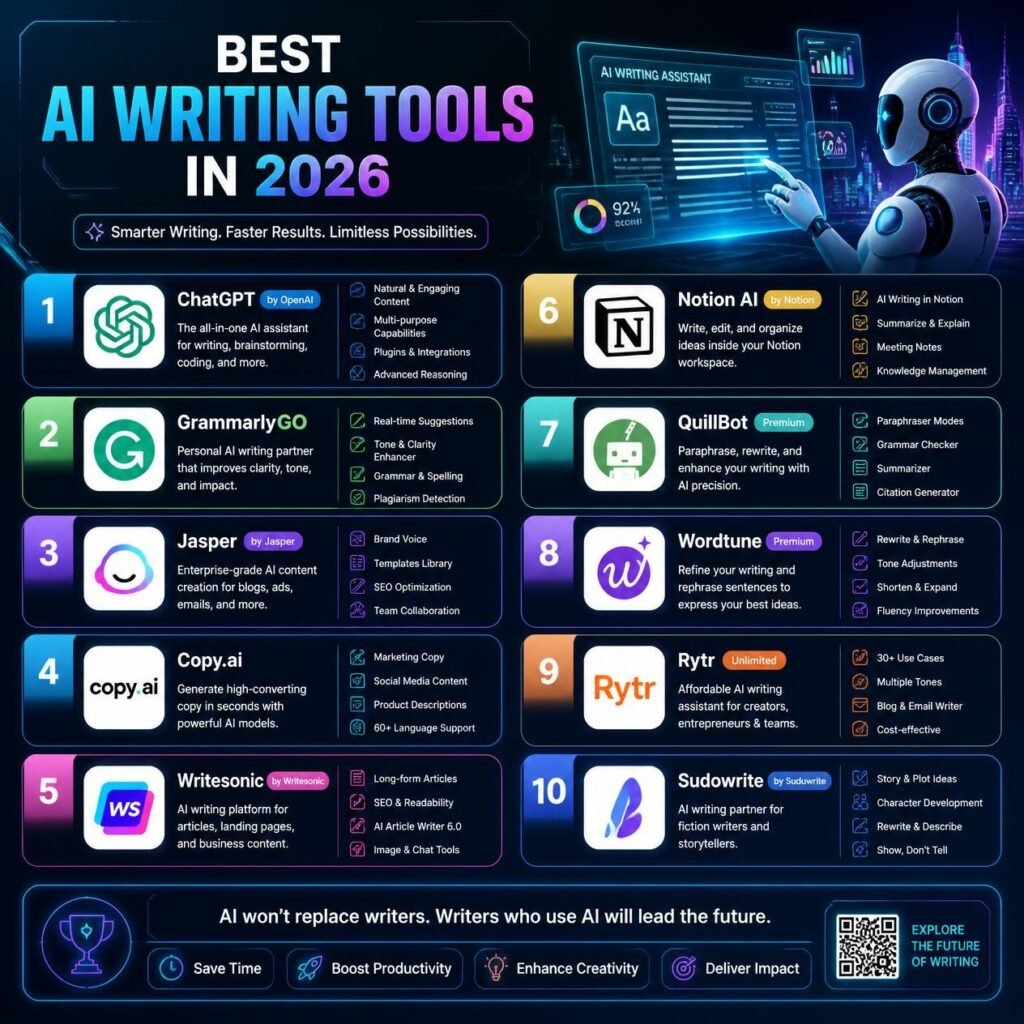
Best AI Writing Tools in 2026 for Bloggers and Content Creators
I used to think the hard part of blogging was having something to say. It wasn’t. The hard part was everything around the saying — the blank cursor blinking at 11 p.m., the SEO checklist I never quite finished, the fourth rewrite of a paragraph that was fine the first time. Somewhere over the last year, that changed, not because I got more disciplined, but because the tools around the writing finally started pulling their own weight.
This isn’t a ranked top-10 with stars out of five. It’s closer to the actual order
I reach for things when a post is due — from the first shapeless idea to the moment it’s finally, actually published.
The First Draft: Getting Something on the Page
Every post starts the same way for me now: not with a blank document, but with a conversation. I open ChatGPT first, almost out of habit, because it’s fast and doesn’t need much setup to get a shape going. <cite index=”29-1″>It’s the fastest at generating drafts and handles the widest range of content types</cite>, which makes it perfect for the messy, exploratory stage — brainstorming angles, testing headlines, throwing out three intros to see which one doesn’t sound like everyone else’s.
But I’ve learned not to trust that first draft too far. <cite index=”29-1″>Long-form articles from it can get repetitive, and it defaults to a “helpful assistant” voice that needs real editing</cite> before it sounds like anything I’d actually publish. So once I know what the post is about, I move it over to Claude. For anything over a couple thousand words — the deep-dive guides, the thought-leadership pieces, the posts I actually want to rank on my own name — <cite index=”29-1″>Claude produces the best long-form content by a meaningful margin: better structure, more nuanced arguments, fewer hallucinations, and a more natural writing style.</cite> It’s also the one that <cite index=”28-1″>excels at following complex instructions and maintaining contextual understanding across a long piece</cite>, so I’m not re-explaining my angle every three paragraphs.
The detail that actually changed how my posts read, though, was <cite index=”28-1″>Claude’s built-in style customization, which lets you upload writing samples so it adapts to match your communication style</cite> instead of handing you generic “AI voice.” I fed it a folder of my own old posts once, half-expecting nothing to change, and the difference in the next draft was immediate — fewer stock phrases, more of my actual cadence.
Keeping Everything From Falling Apart Mid-Series
The thing nobody warns you about is that AI drafting tools are great at one post and genuinely bad at remembering the twelve posts around it. My content calendar, my pillar-and-cluster map, my audience notes — all of it used to live in scattered docs that no chat tool could see at once.
Storyflow fixed that specific headache. <cite index=”30-1″>The AI reads your full active content canvas, so your calendar, pillar map, audience notes, and post outlines all sit in one place it can actually see</cite> — which sounds like a small thing until you’ve lost the thread of a five-part series inside a chat tab that forgot post two existed. <cite index=”30-1″>Most working bloggers in 2026 run three or four tools together, not one</cite>, and this is usually the one holding the other three in formation.
Making Sure It Actually Gets Found
A beautifully written post that nobody sees is just a diary entry. This is where I stopped resisting SEO tools and started treating them as part of the actual writing process, not an afterthought bolted on at the end.
Surfer SEO is the one I open before I even finish a draft now, not after. <cite index=”33-1″>Paired with a drafting tool, it scores content for both traditional Google search and the newer AI-search citations</cite> that increasingly decide whether your post gets quoted by a chatbot instead of just ranked on a results page. Frase does similar work from a different angle — <cite index=”32-1″>it’s especially good for research and content planning, helping align what you’re writing with what’s already ranking.</cite>
For a lighter touch, NeuronWriter earned its spot by being weirdly good at suggesting the semantic keywords I never would have thought of myself — the kind of long-tail phrasing that quietly pulls in traffic a headline keyword alone never catches.
If budget is the real constraint, and for a lot of bloggers it is, Koala AI is worth knowing about. <cite index=”33-1″>At around $9 a month, it produces surprisingly good SEO-optimized posts</cite>, and <cite index=”26-1″>it’s particularly popular among bloggers and affiliate marketers who need to produce a high volume of content quickly</cite>, complete with heading structure and internal linking suggestions built in.
Brand Voice, at Scale
Solo blogging is one problem. Keeping five writers sounding like the same publication is a completely different one, and it’s the one Jasper was actually built to solve. <cite index=”33-1″>It now ships with over 100 specialized AI agents and Content Pipelines that automate the full content lifecycle from idea to publishing</cite>, but the feature that made me recommend it to a friend running a small content team is still the original one: <cite index=”28-1″>Brand Voice, which trains the AI on existing content so every piece of output aligns with established guidelines</cite>, no matter which writer typed the prompt.
It’s not cheap, and it’s genuinely overkill if you’re one person writing one blog. But <cite index=”33-1″>for teams, it’s what keeps content consistent across multiple writers</cite> in a way that copying a style guide into a chat prompt never quite manages.
The Polish Pass Nobody Skips
Every single post, no matter which tool drafted it, goes through Grammarly last. It’s not glamorous, and it doesn’t generate anything — <cite index=”34-1″>it’s used after writing to clean up the content</cite>, catching the small stuff so I stop noticing it myself. After thousands of words a week, that quiet, unglamorous pass is still the one step I’ve never once considered skipping.
The Honesty Check I Didn’t Expect to Need
Here’s the part I didn’t see coming a year ago: I now run my own writing through an AI detector before I publish, not because I’m hiding anything, but because heavily-edited AI drafts sometimes still read as flat or synthetic in ways I can’t hear myself. Tools built for this, like the ones publishers use to scan submitted work, <cite index=”30-1″>check for both AI-content patterns and plagiarism in the same scan</cite>, and treating that score as a signal rather than a verdict has genuinely made my final drafts better — it’s usually pointing at the paragraph I was least confident in anyway.
What This Actually Looks Like Week to Week
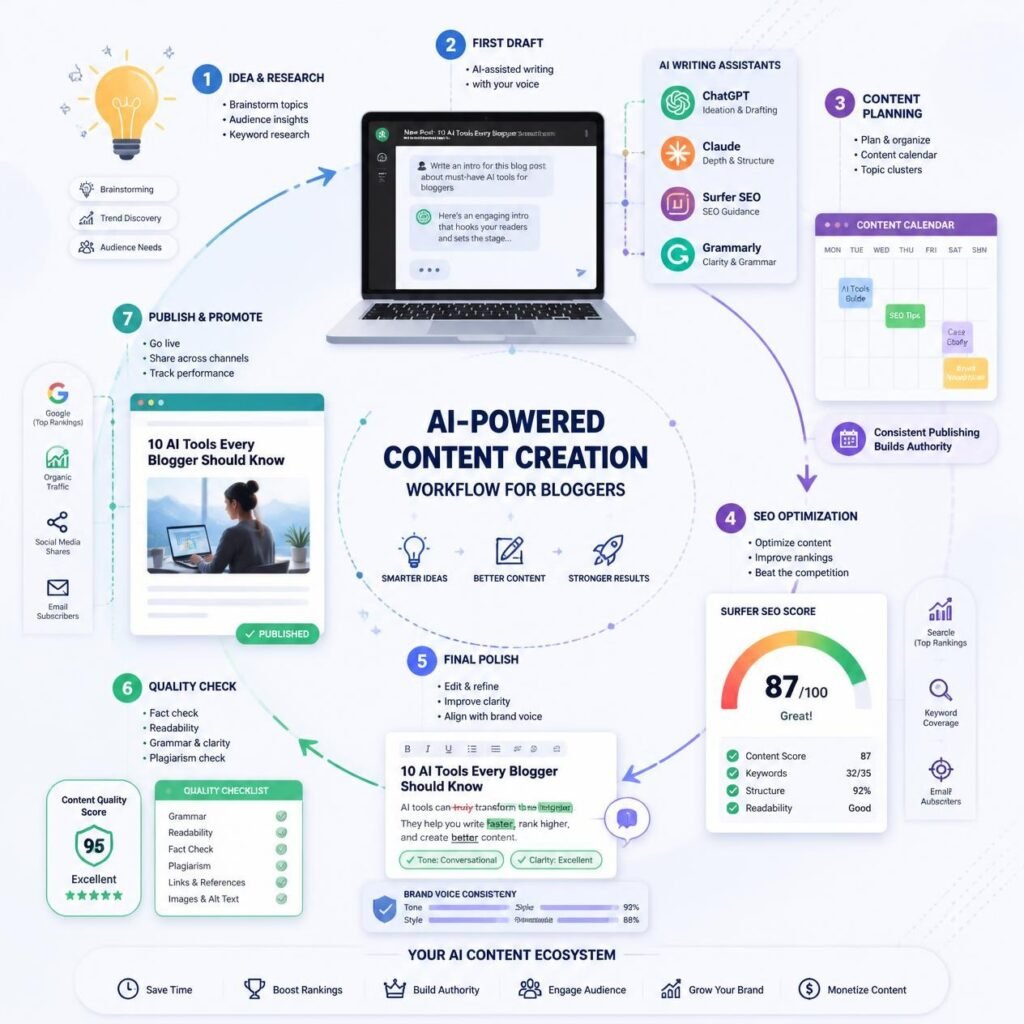
If I had to describe my real stack, not the aspirational one, it’s four tools working in sequence: <cite index=”30-1″>one for planning, one for drafting, one for SEO, and one for polish</cite>. Concretely, that’s Storyflow to keep the calendar and outlines coherent, Claude or ChatGPT to actually write, Surfer or Frase to make sure the post can be found, and Grammarly to catch what’s left.
None of this replaces the part that was never really the hard part to begin with — having something worth saying. <cite index=”29-1″>Bloggers publishing original thought leadership and educational content still outperform those relying on AI-only material</cite>, and every tool on this list exists to protect the time and energy that actual thinking takes, not to replace it. The tools got faster. The point of writing didn’t change at all.
Best Ai Productivity Tools