Best AI Video Generators in 2026: Create Videos With AI
I still remember the first time I tried to make a video without a camera. It felt a little like cheating — like I’d skipped a step everyone else had to earn through years of editing software and expensive gear. First, I typed a sentence describing a scene. Then, a few seconds later, an actual moving clip appeared, complete with lighting and camera movement I never asked for but somehow got right. Since then, I haven’t stopped experimenting, and along the way I’ve learned that “best” AI video generator is the wrong question to even ask. The better question is: best for what?
So, rather than crown one winner, let me walk you through how I actually landed on the tools I use now — the mistakes first, the favorites second, and the honest trade-offs in between.
First, the Models Matter More Than the Apps
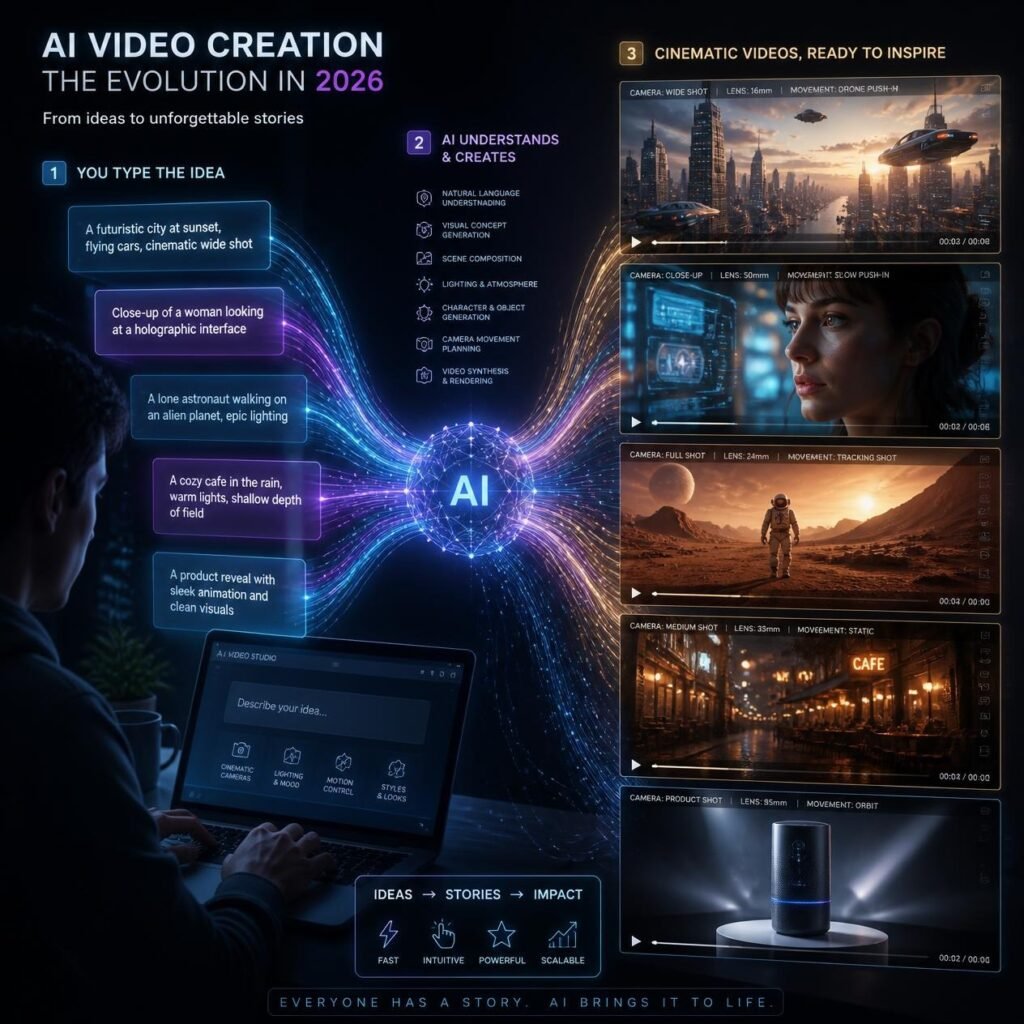
Before picking a platform, I had to unlearn something. I assumed the app was the tool. It isn’t, not really. <cite index=”11-1″>The generators in 2026 are platforms that turn prompts, images, and scripts into finished clips, while the underlying models — Veo, Sora, Kling, Seedance — are what actually set the ceiling for motion and fidelity.</cite> In other words, the app is the kitchen, but the model is the recipe. Once that clicked, I stopped judging an app by its interface alone and started asking which models it gave me access to.
With that in mind, here’s where I actually landed.
For Realism: Google Veo
If you only try one thing from this list, start here. Consequently, it’s the tool I recommend first to anyone asking “where do I even begin?” <cite index=”12-1″>Veo 3.1 is widely considered the best AI video generation all-arounder on the market, with strong prompt adherence, great realism combining video and audio, and robust creative tools.</cite> The first time I generated a clip and had to pause to remember it wasn’t real footage, I understood the hype.
What surprised me most, though, wasn’t the polish — it was the control. <cite index=”12-1″>You can start a project with a conventional text-to-video prompt, a set of frames, or even ground the model with multiple reference images and text at once, so the results stick closely to everything you feed it.</cite> That last part matters more than it sounds. Early on, I’d generate a character in one clip and lose them completely in the next. Grounding the model in references finally fixed that.
Meanwhile, independent testing backs this up rather than just marketing copy repeating itself. <cite index=”16-1″>Across benchmark testing and real production workflows, Veo 3.1 still offers the best overall mix of realism, motion quality, prompt following, and native audio support — making it the safest single recommendation if you only want one answer.</cite>
veo
For Motion and Physics: Kling and Seedance
Once I’d gotten comfortable with realism, I ran into a different problem: fast movement. Veo is excellent, but action scenes — dance, sports, anything with a lot of physical motion — are a different beast entirely. That’s where Kling and Seedance earned their place in my stack.
<cite index=”10-1″>Kling 3.0 fits high-motion scenes especially well</cite>, and after testing it on a few action-heavy prompts, I understood why. It handles the kind of chaotic, physical movement that used to make older models fall apart into warped limbs and impossible physics.
Seedance, meanwhile, impressed me for a different reason. <cite index=”13-1″>In testing, it proved to be an incredibly powerful model physics-wise, creating movement that had real weight and volume to it</cite> — something a lot of competing tools still fake unconvincingly. That said, nothing is perfect: <cite index=”13-1″>if you look closer, there are artifacts, warped details, and overpolished, plasticky edges in the background</cite>, so I’ve learned to keep my shots relatively tight rather than let the background do too much work.
For anyone doing commercial-style work specifically, this pairing is hard to beat. <cite index=”14-1″>Seedance 2.0 offers the strongest prompt adherence, accepts up to 12 reference inputs, includes native audio, and produces clips up to 15 seconds in a single pass</cite> — which, frankly, saved me from stitching together three separate generations just to get one usable scene.
Explore Kling & Seedance
For Storytelling: Sora
There’s a difference between generating a shot and generating a scene that means something, and this is where Sora quietly separates itself. <cite index=”10-1″>Sora 2 fits narrative concepting and polished visual mood</cite> better than most alternatives I’ve tried, particularly when I’m still figuring out how a story should feel before locking anything down.
For longer-form, dialogue-driven work, its professional tier goes even further. <cite index=”18-1″>Sora 2 Pro is built for long, realistic narratives with advanced world simulation and synced dialogue</cite>, which makes it the closest thing I’ve found to previsualizing an actual short film rather than a single isolated clip.
Explore Sora
For Camera Control: Runway
Eventually, I hit a wall that had nothing to do with realism or motion — it was about control. I wanted to direct a shot, not just describe one. That’s exactly the gap Runway fills. <cite index=”15-1″>The Gen-4 model handles camera movements like pan, tilt, and zoom with a precision that no other tool quite matches</cite>, alongside motion brushes and the ability to train on your own visual style.
However, I’ll be honest about the catch, because it genuinely tripped me up the first time. <cite index=”15-1″>Runway’s free tier advertises 125 one-time credits, but that only gets you approximately two to three short test clips, and once they’re gone, they don’t refresh</cite> — so treat it as a trial, not a real free plan. Even so, the paid tiers are good enough that I still think the free credits are worth using just to get a feel for the camera controls before committing.
Explore Runway
For Working Across Models Without Losing Your Mind
Eventually, switching between five different apps for five different models got exhausting. That’s when I discovered the appeal of multi-model platforms like Higgsfield and ImagineArt, which host several engines under one subscription instead of forcing you to juggle logins and separate credit systems.
<cite index=”14-1″>The trade-off is straightforward: single-vendor platforms sometimes get new model versions first and price one model cheaply, but a multi-model platform wins the moment your work spans engines — one subscription, one credit system, one workspace.</cite> For me personally, that was the deciding factor. I don’t work in just one style, so I didn’t want to be locked into just one model.
That said, before you get seduced by “unlimited” claims, pay attention to the fine print. <cite index=”11-1″>Avoid optimizing only for “free unlimited” offers — credit fine print usually dominates</cite> once you actually try to use the thing at scale.
For Quick, Low-Friction Wins
Not every project needs cinema-grade output, and honestly, some days I just need something fast for a social post. On those days, InVideo has become my go-to. <cite index=”15-1″>Typing a simple scene description can pull relevant stock footage, add background music, generate a voiceover, and deliver a fully edited clip in about 90 seconds</cite> — no camera controls, no reference images, just a finished thing I can post before my coffee gets cold.
Similarly, if short-form, fast experimentation is the whole point, <cite index=”16-1″>PixVerse remains one of the easiest places to start for short-form output and low-friction results without learning a full pro workflow.</cite>
So, Where Should You Actually Start?
If all of this feels like a lot, that’s fair — it was for me too. But here’s the shortcut I wish someone had given me a year ago: start with Veo if you want one reliable, realistic all-arounder. Move to Kling or Seedance once motion and physics become the bottleneck. Reach for Sora when the story matters more than any single shot. Pick up Runway the moment you want real camera control instead of happy accidents. And finally, if you’re working across all of the above, consolidate into a multi-model platform before your subscriptions multiply past what you can actually track.
None of these tools replaced my creativity, and honestly, I don’t think they were ever meant to. What they replaced was the distance between having an idea and actually seeing it — and that distance, more than any single feature, is the real story of AI video in 2026.