
If you’ve listened to an AI-narrated audiobook, chatted with a voice-based customer support agent, or watched a dubbed video where the actor’s lips somehow matched a language they never actually spoke, there’s a good chance ElevenLabs was behind the voice. What began in 2022 as a text-to-speech experiment by two engineers has grown into one of the most influential companies in the AI audio space — a platform that now touches everything from podcasting to enterprise call centers to full-blown AI-generated music.
This post takes a closer look at what ElevenLabs is, how it works, what it’s good at, and where it still has room to grow.
From Two Founders to an $11 Billion Company
ElevenLabs was founded by Piotr Dąbkowski, a former Google machine learning engineer, and Mati Staniszewski, who previously worked in deployment strategy at Palantir. Both grew up in Poland, and the company’s name is a nod to that heritage — “Eleven” references November 11th, Poland’s National Independence Day. The “Labs” part signals the company’s research-driven identity.
What started as a bet that AI-generated speech could sound genuinely human rather than robotic has scaled dramatically. The company has gone through several funding rounds backed by investors including Andreessen Horowitz, Sequoia Capital, and ICONIQ, and by early 2026 it had raised additional capital at an $11 billion valuation while reportedly eyeing a future public listing. Poland’s state-backed investment vehicle has also taken a stake, a notable vote of confidence from the founders’ home country. The company now operates out of offices in New York, London, and Warsaw, and its technology reportedly underpins voice, agent, and audio features at companies like Meta, Twilio, Chess.com, Deutsche Telekom, and Klarna.
What ElevenLabs Actually Does
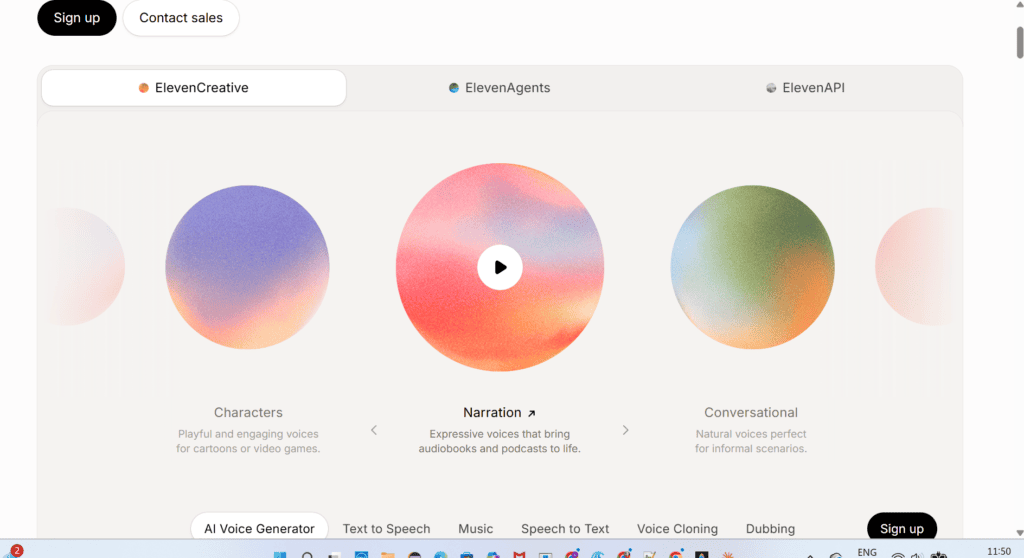
At its core, ElevenLabs is a speech and audio AI company, but describing it purely as “text-to-speech” undersells how far the platform has expanded. Today it spans several interconnected products.
Text-to-Speech and Voice Cloning
This is where ElevenLabs made its name. Rather than reading text in a flat, monotone way like older TTS engines, ElevenLabs’ models interpret context — adjusting pacing, emphasis, and emotional tone based on what’s actually being said. The flagship model, Eleven v3, supports speech generation across dozens of languages and introduced a feature called Audio Tags, which lets creators insert bracketed emotional cues like [whispers], [sighs], or [laughs] directly into a script to direct the performance with far more precision than plain text alone allows.
Voice cloning is arguably the platform’s most talked-about capability. Using just a short audio sample, users can create a synthetic replica of a voice — their own, a fictional character’s, or a custom voice built from scratch through the platform’s Voice Design tools. The Voice Library lets users browse and use community-created voices, organized into collections tailored for specific use cases like radio announcing, customer support, or trailer narration.
Conversational AI Agents
ElevenLabs has pushed heavily into agentic voice technology through what it calls ElevenAgents. These aren’t just voices reading scripts — they’re real-time conversational systems capable of handling phone calls, processing tasks like refunds or order tracking through function calling, and even de-escalating frustrated customers using expressive vocal controls. This has positioned ElevenLabs as an infrastructure provider for companies looking to modernize call centers and customer support without relying on rigid, menu-driven IVR systems. The developer platform behind this includes SDKs for JavaScript, Python, and React, along with compliance support for standards like SOC 2, HIPAA, and GDPR — a signal that ElevenLabs is courting serious enterprise customers, not just hobbyists.
Scribe: Speech-to-Text
On the transcription side, ElevenLabs offers Scribe, its automatic speech recognition system. The newer Scribe v2 Realtime model is built for low-latency, high-accuracy transcription in live settings — meetings, phone calls, and agentic workflows where correctly understanding speech in real time matters as much as generating it. The company has been actively deprecating older transcription models in favor of this more capable version.
Music Generation
Perhaps the most surprising expansion has been into music. Eleven Music allows users to generate original tracks with control over genre, structure, instrumentation, and vocals, in multiple languages. It’s cleared for commercial use across film, TV, advertising, and gaming, and was developed in partnership with record labels and artists rather than existing purely as a black-box generator. In a notable showcase of the technology, ElevenLabs released “The Eleven Album” in January 2026, a project involving established artists like Liza Minnelli and Art Garfunkel, intended to demonstrate what studio-quality, fully AI-assisted music production could sound like.
Studio and Video
ElevenLabs’ Studio has evolved into a unified editor that combines audio editing, video editing, music generation, captioning, and voice isolation in a single interface. The company has also integrated third-party video generation models to let users produce short AI-generated video clips with synchronized, lip-synced audio — effectively turning ElevenLabs into a broader multimodal content creation platform rather than a pure audio tool.
Why It’s Gained So Much Traction
A few things explain ElevenLabs’ rapid rise. First, audio quality: the emotional nuance and naturalness of its voices set a new bar when the company first launched, and it has largely maintained that edge as competitors have caught up. Second, developer accessibility: a well-documented REST API, official SDKs, and streaming support have made it relatively painless for engineering teams to bolt AI voice into existing products. Third, breadth: few competitors offer voice, transcription, music, and video generation under one roof, which makes ElevenLabs an attractive single vendor for teams that don’t want to stitch together multiple AI providers.
The conversational agent business in particular seems to be where a lot of current momentum lives, as enterprises look to replace traditional phone-tree support systems with agents that can actually hold a fluid conversation.
The Elephant in the Room: Misuse and Trust
A platform this good at cloning voices was always going to raise safety concerns, and ElevenLabs has had its share of controversy. In early 2024, AI-generated robocalls impersonating a U.S. president’s voice were traced back to ElevenLabs’ technology and used in an attempt to discourage voters ahead of a primary election. The incident became a widely cited example of the risks tied to accessible voice cloning tools, and it pushed ElevenLabs to talk more publicly about misuse prevention — including tools like an AI Speech Classifier designed to detect whether a given audio clip was generated using its technology.
The company has continued to invest in safeguards, such as guardrail-triggered events in its conversational AI SDKs that can detect and flag policy violations during live conversations. Still, the underlying tension remains: the more realistic and accessible voice cloning becomes, the harder it is to prevent misuse entirely, and responsibility increasingly falls on downstream users and platforms to manage consent and disclosure properly.
On a more positive note, ElevenLabs has also put resources toward socially beneficial uses of its technology, including a pledge to provide free voice restoration services to a large number of people who have permanently lost their ability to speak — using the same underlying cloning technology for something clearly constructive.
Pricing and Practical Considerations
ElevenLabs runs on a credit- or character-based subscription model rather than flat per-seat pricing, which means costs scale with how much audio you actually generate. This tends to work well for teams with predictable, moderate content needs, but heavy users — audiobook publishers producing enormous volumes of narration, or businesses running always-on voice agents — need to model their expected usage carefully, since per-character costs can add up quickly at scale. The platform is cloud-hosted only, so organizations with strict data residency or air-gapped infrastructure requirements will want to look closely at enterprise-tier options or consider whether ElevenLabs is the right fit at all.
Where This Leaves Us
ElevenLabs has moved well beyond its original identity as a text-to-speech novelty. It’s now a genuine infrastructure layer for AI audio and, increasingly, multimodal content — powering everything from customer service calls to original music releases. That expansion has come with real scrutiny around misuse, and the company will likely keep navigating that tension as voice cloning technology becomes more powerful and more widely available.
For developers and businesses, the appeal is fairly clear: strong audio quality, a broad and constantly evolving product suite, and solid documentation make it a practical default choice. For everyone else, ElevenLabs is a useful case study in just how fast “AI voice” has gone from a curiosity to something baked into products we use every day — and a reminder that the tools capable of the most good are often the same ones capable of doing real harm if left unchecked.
Useful Links:
https://try.elevenlabs.io/digitalsavvyzone