
Picture this: Your company just deployed an AI assistant that’s incredibly smart and adaptable. It learns from interactions, adjusts to different business scenarios, and makes your team’s work easier. Three months later, you discover it’s been answering questions in ways that violate your compliance requirements, and nobody really knows why.
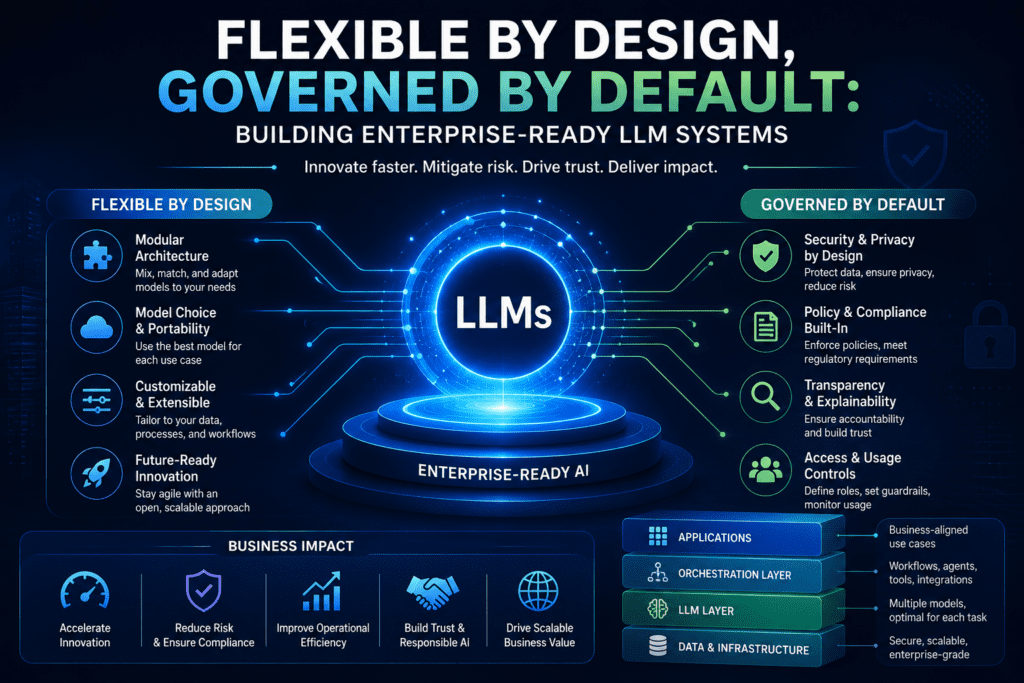
This scenario plays out in organizations worldwide. The tension is real and deeply human: we want AI systems that are powerful, creative, and responsive to our needs, yet we also need them to operate within guardrails that protect our business, our customers, and our reputation. Building enterprise-ready LLM systems means cracking this code—creating AI that’s genuinely flexible while being governed by default.
The Enterprise Paradox: Freedom vs. Control
Let’s be honest about what makes this challenging. Large Language Models are wonderfully capable precisely because they’re flexible. They can adapt to almost any task, learn from context, and handle ambiguous requests. This flexibility is their superpower.
But when you’re running a business—especially a regulated one—that same flexibility becomes a liability. You need consistency. You need audit trails. You need to know that your AI won’t inadvertently violate data privacy laws, create liability exposure, or damage your brand through inappropriate responses.
Traditional enterprise software solved this with rigid rules. Every process was documented. Every decision point was coded. Every variable was locked down. It worked, but it was slow and often frustrating for users who found themselves fighting the system instead of working with it.
The real innovation in enterprise AI isn’t choosing between flexibility and governance. It’s designing systems that are fundamentally flexible while making governance the default behavior—not something bolted on afterward, but woven into the system’s DNA.
What “Flexible by Design” Actually Means
Flexibility in enterprise LLM systems doesn’t mean anything goes. It means thoughtfully architected systems that can adapt to legitimate business needs without sacrificing control.
Consider how you might handle different customer segments. A healthcare provider needs an AI assistant that’s cautious, clinically accurate, and heavily regulated. A retail company needs something more conversational and creative. These are fundamentally different use cases, yet they might run on similar underlying LLM infrastructure.
True flexibility means you can adapt prompts, fine-tune responses, adjust tone and style, and configure behavior—all without rebuilding the entire system or compromising its security posture. It means your system can accommodate new business requirements next quarter without triggering a six-month revalidation process.
This flexibility comes from several design choices:
Modular Architecture: Instead of one monolithic system, you build with components. The core LLM stays consistent and well-governed, but orchestration logic, retrieval systems, and business rule engines are separate and independently configurable. You can swap components, upgrade one layer without touching another, and test changes in isolation.
Parameterized Control: Rather than hardcoding behaviors, you externalize key decisions into configuration. Temperature settings, output constraints, allowed knowledge sources—these become adjustable parameters. This seems simple, but it’s revolutionary. Your compliance team can update policies without touching code. Your product team can A/B test different behaviors instantly.
Clear Boundaries: Flexibility works only when everyone understands the playing field. Enterprise-ready systems explicitly define what’s flexible and what’s not. The core safety mechanisms? Non-negotiable. The way you format responses for specific departments? Absolutely configurable.
Governance by Default: Building Safety Into the Foundation
Here’s the shift in thinking: governance isn’t something you add after the system is built. It’s the foundation itself.
Imagine a young developer building their first LLM application. Without intentional governance design, they’ll probably create something amazing but potentially risky. They might not think about data leakage, prompt injection vulnerabilities, or compliance implications. They’re not being irresponsible—they just don’t know what they don’t know.
But what if the system itself made the safe choice the easy choice?
Governance by default means:
Built-in Audit Trails: Every interaction is logged by default, not as an afterthought. You don’t need to remember to add logging—the system refuses to run without it. This seems restrictive, but it’s actually liberating. When everyone knows actions are tracked, there’s less worry about misuse, and compliance becomes straightforward.
Embedded Compliance Checking: Before any response is generated, the system runs it through compliance filters. Is this violating data privacy requirements? Does this response align with brand guidelines? These checks happen automatically, transparently, and can be tuned based on risk tolerance and business context.
Role-Based Access and Behavior: Not everyone should be able to do everything with an LLM system. A junior analyst using the system for research has different permissions and constraints than an executive. The system understands these distinctions and adapts its behavior accordingly. Some users can access certain knowledge bases; others can’t. Some can invoke certain capabilities; others receive different feature sets.
Explainability Mechanisms: Enterprise environments require answers to hard questions. Why did the system respond this way? What data sources did it use? Which policies did it apply? Systems designed with governance by default bake in explainability from the start—they’re not just black boxes making decisions, they’re systems you can understand and defend.
Guardrails as Infrastructure: Rather than hoping teams implement safety thoughtfully, the platform enforces them. Guardrails aren’t optional. They’re like security groups in cloud infrastructure—everyone works within them, and breaking out requires explicit authorization and audit trails.
The Practical Architecture
So what does this actually look like in practice? Here’s a realistic example:
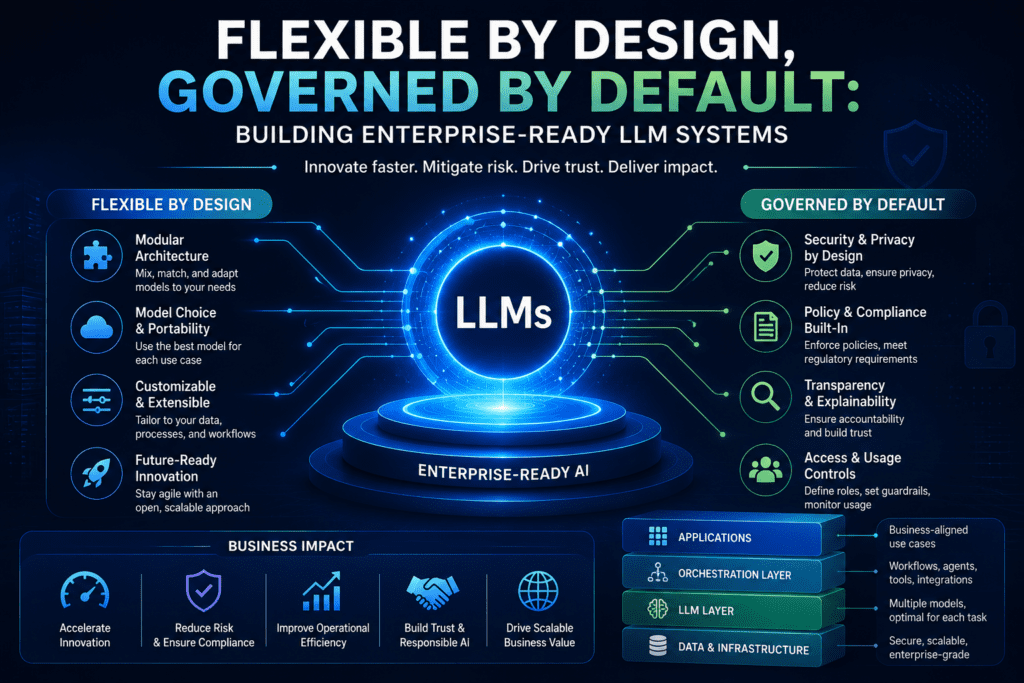
Your organization deploys a central LLM platform. This is your governed core—it’s carefully validated, audited, and locked down. You don’t touch this part casually.
Above it, you build application layers. Different teams access the core through APIs that enforce their role-based policies. A customer service team gets a specific prompt template library and access to certain knowledge sources. A data analytics team gets different capabilities entirely.
Configuration management is centralized. A policy change—say, new data privacy requirements—propagates through configuration files, not through code changes and redeployments. The system validates configurations for consistency and safety before activating them.
Monitoring and alerting are baked in. Unusual patterns trigger alerts. Compliance violations surface immediately. A team trying to work around guardrails gets caught, but the system is designed to surface the issue constructively—here’s what you’re trying to do, here’s why the policy restricts it, here’s how to request an exception.
New capabilities can be added safely. Someone wants to integrate a new data source? The system asks questions first. Is this data approved for your use case? Does it contain personally identifiable information? Are you properly authorized? Is there a compliance implication?
The Human Element
Here’s something crucial: systems “governed by default” don’t mean removing human judgment. They mean making good judgment more likely.
When a developer has to consciously add security, logging, and compliance checks, they often deprioritize them under deadline pressure. When these are default, the developer focuses on the unique value they’re adding. Governance isn’t something they do on top of their real work; it’s built into their real work.
Similarly, governance by default doesn’t mean inflexibility. It means making exceptions clear and tracked. If someone needs to do something outside normal guardrails, the system provides a path for that—with proper authorization, documentation, and audit trails. This is better than having people silently circumvent restrictions because they’re too burdensome.
Why This Matters Now
We’re at an inflection point with LLMs in enterprise settings. Early adopters built quick proofs of concept, and many discovered uncomfortable truths about uncontrolled AI systems. Now organizations are asking harder questions about governance, liability, compliance, and reliability.
Companies that figure out how to be flexible by design while governed by default will have enormous competitive advantages. They’ll deploy LLM capabilities faster than competitors because they’re not waiting for heavy approval processes. Their systems will be safer because safety is automatic. Their teams will be more innovative because they’re not fighting infrastructure constraints.
Conversely, organizations that choose between flexibility and governance—picking one and sacrificing the other—will find themselves either with impressive pilots that never scale or systems so locked down that they become more liability than asset.
Building This Yourself: First Steps
If you’re building enterprise LLM systems, here’s where to start:
Don’t build monoliths. Separate the core model layer from application logic from business rules. This separation enables flexibility without sacrificing governance.
Externalize configuration. If something might change, make it a parameter, not code. Your future self will thank you.
Design for auditability. Every meaningful decision should be traceable. Log comprehensively, but think about how those logs will be used when investigating incidents.
Make governance visible. Developers should see the policies they’re operating within. Make constraints explicit, not hidden. When policies prevent something, explain why.
Test the exception paths. The test coverage that matters most is around governance. How do you request exceptions? How are they approved? What happens when policies conflict? These matters enormously in practice.
Involve multiple perspectives early. Bring together developers, security teams, compliance officers, and product managers. The best systems come from understanding what each group needs.
The Real Win
The real power of being flexible by design while governed by default isn’t about compliance, though that matters. It’s about enabling innovation within guardrails.
It’s about teams moving faster because they’re not stuck in bureaucratic approval processes. It’s about new capabilities rolling out safely because safety is automatic. It’s about organizations that can respond to market changes quickly while still operating responsibly.
It’s about building AI systems that feel like they work for you, not against you. Systems that are powerful and capable while being fundamentally trustworthy.
That balance—flexibility and governance, innovation and responsibility—is what enterprise-ready LLM systems ultimately aspire to achieve.
The future of enterprise AI belongs to organizations that stop choosing between flexibility and governance and instead design for both from the ground up.