Best AI Resume Builders in 2026
There’s a particular kind of silence that follows sending out thirty applications and hearing nothing back. Not a rejection, not even an automated “thanks, but.” Just silence. I lived in that silence for longer than I’d like to admit before I finally accepted that the problem probably wasn’t my experience — it was that my resume was getting filtered out before a human ever laid eyes on it.
So, rather than keep guessing, I actually tested my way through the current crop of AI resume builders, the same way I’d test anything else that promised to fix a problem I’d been quietly stuck on for months. Here’s what that search looked like, in the order it actually happened.
First, I Had to Understand What Was Actually Filtering Me Out
Before touching a single tool, I needed to understand the real obstacle. It turns out it wasn’t taste, or formatting preference, or bad luck — it was software. <cite index=”40-1″>Most resumes get caught up in screening nets and never see human eyes</cite>, which meant every resume I’d sent for months might have been technically well-written and still invisible. That single realization reframed the whole search: I wasn’t looking for a prettier resume. I was looking for one that could actually get read.
With that in mind, I stopped chasing templates and started chasing three things specifically: <cite index=”39-1″>time-saving content generation, ATS-friendly formatting without excessive graphics, and language that made bullet points more concise and action-driven while staying personal rather than generic.</cite>
Then, I Started With the Highest-Scoring ATS Tool
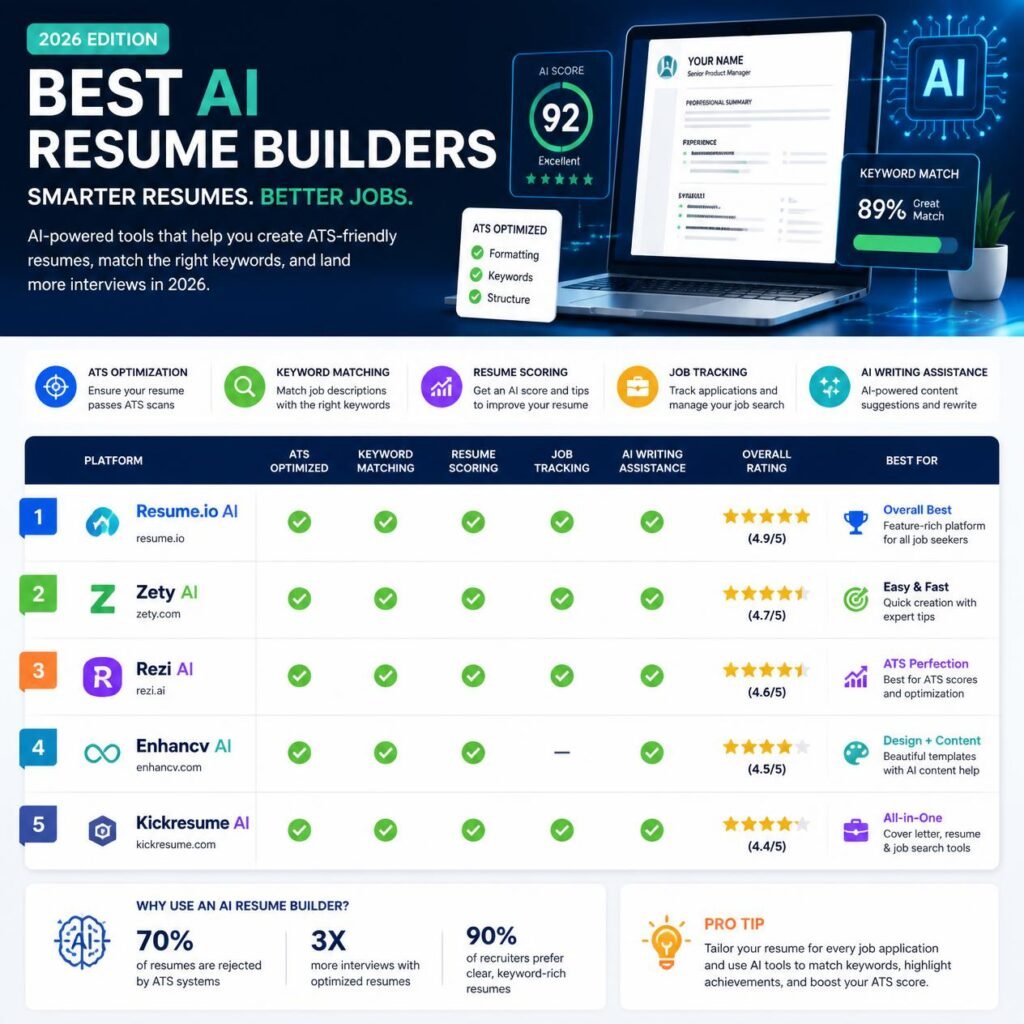
Naturally, I went straight for the tool with the strongest reputation on the exact problem I had. Rezi built its entire identity around this. <cite index=”43-1″>Its real-time scoring system gives you a number from 1 to 100 as you edit — genuinely satisfying, almost addictive — while the AI scans job descriptions and highlights keywords you should incorporate, with a bullet point generator that focuses on metrics and achievements.</cite>
Independent testing backed this up rather than just Rezi’s own marketing. <cite index=”39-1″>Across a full comparison of AI resume builders, Rezi came out as the top pick for the most robust, ATS-compliant experience.</cite> Consequently, if ATS filtering was your single biggest fear the way it was mine, this is genuinely the first tool worth opening.
Meanwhile, Starting From a Blank Page Sent Me Somewhere Else
However, Rezi assumes you already have something to refine, and on my worst days, I didn’t. I had a job title and a vague sense of panic. For that specific problem — the actual blank page — Kickresume became the better starting point. <cite index=”38-1″>It can generate a full first draft from minimal input and then guide users through improving each section, which reduces overwhelm and speeds up the process for first-time resume writers</cite> especially.
Separately, testing across multiple tools confirmed this wasn’t just my own bias. <cite index=”44-1″>Kickresume produced the strongest first drafts for career summaries and bullets among every tool tested</cite>, which made it my go-to whenever I needed momentum more than precision.
After That, Tailoring Became the Real Skill I Was Missing
Eventually, I realized generating a resume was never the hard part — tailoring it to this specific job was. Sending the same document to thirty different postings was probably half of why I’d been met with silence in the first place. This is where ResuFit quietly earned a permanent spot in my process. <cite index=”43-1″>It tailors your resume to specific job descriptions in seconds, and its ATS scoring catches formatting issues that other tools miss</cite>, all without forcing me behind a paywall just to see whether the tailoring actually helped.
Interestingly, its free plan wasn’t a stripped-down teaser either. <cite index=”43-1″>You get CV analysis, keyword optimization, and PDF downloads without hitting a paywall</cite> — which meant I could genuinely evaluate the tool before committing a dollar to it, rather than being sold on promises alone.
At the Same Time, I Learned Not to Trust Design Alone
Somewhere in the middle of testing, I fell for a tool purely because the output looked stunning. It was a useful mistake to make early, because it taught me something important: <cite index=”44-1″>a resume can look genuinely polished while the underlying content remains whatever you originally wrote — a builder can offer the cleanest template output while doing essentially nothing for tailoring.</cite> Zety, for instance, fell into exactly this category in testing — beautiful, but not built to solve the filtering problem at all.
So, if design and formatting are the priority rather than ATS optimization specifically, a tool like Zety still has a place. Just pair it with a separate keyword or ATS tool rather than expecting one product to do both jobs well.
For the Bigger Picture, One Tool Handled More Than Just the Document
By this point, I noticed something else missing from my process entirely — I had no real system for tracking who I’d applied to, what I’d sent them, or when to follow up. Teal solved that gap by refusing to be just a resume builder in the first place. <cite index=”44-1″>It combines a job tracker with a resume builder in one workflow</cite>, which meant the resume itself stopped being an isolated document and became part of an actual, organized job search instead of thirty disconnected PDFs scattered across my downloads folder.
Finally, for Anyone Applying Internationally, One Free Tier Stood Out
Toward the end of my testing, a friend applying for roles across three different countries asked which tool I’d recommend for her specifically, and the honest answer wasn’t any of the ones I’d leaned on so far. <cite index=”44-1″>Novoresume offers the most generous free access among every tool tested, making it especially well-suited for international job seekers</cite> who need to experiment across different resume conventions without hitting a paywall at every turn.
So, Where Should You Actually Start?
If you’re standing exactly where I was, staring at silence instead of interviews, here’s the order I’d genuinely recommend. Start with Rezi if ATS filtering is your primary fear. Move to Kickresume the moment the blank page itself is the obstacle. Bring in ResuFit once you have a draft and need to tailor it, job by job, without paying for every attempt. Stay wary of tools like Zety if formatting is all they’re offering. Add Teal if the real problem is organization, not just the document itself. And if you’re applying across borders, give Novoresume’s free tier a real look before anything else.
None of these tools replaced the actual experience sitting behind my resume — the projects, the wins, the years of work that got me here. What they replaced was the guessing: the not knowing whether my resume was even making it past the software before a person ever saw it. That clarity, more than any single feature, is what finally broke the silence.
There’s a particular kind of silence that follows sending out thirty applications and hearing nothing back. Not a rejection, not even an automated “thanks, but.” Just silence. I lived in that silence for longer than I’d like to admit before I finally accepted that the problem probably wasn’t my experience — it was that my resume was getting filtered out before a human ever laid eyes on it.
So, rather than keep guessing, I actually tested my way through the current crop of AI resume builders, the same way I’d test anything else that promised to fix a problem I’d been quietly stuck on for months. Here’s what that search looked like, in the order it actually happened.
First, I Had to Understand What Was Actually Filtering Me Out
Before touching a single tool, I needed to understand the real obstacle. It turns out it wasn’t taste, or formatting preference, or bad luck — it was software. <cite index=”40-1″>Most resumes get caught up in screening nets and never see human eyes</cite>, which meant every resume I’d sent for months might have been technically well-written and still invisible. That single realization reframed the whole search: I wasn’t looking for a prettier resume. I was looking for one that could actually get read.
With that in mind, I stopped chasing templates and started chasing three things specifically: <cite index=”39-1″>time-saving content generation, ATS-friendly formatting without excessive graphics, and language that made bullet points more concise and action-driven while staying personal rather than generic.</cite>
Then, I Started With the Highest-Scoring ATS Tool
Naturally, I went straight for the tool with the strongest reputation on the exact problem I had. Rezi built its entire identity around this. <cite index=”43-1″>Its real-time scoring system gives you a number from 1 to 100 as you edit — genuinely satisfying, almost addictive — while the AI scans job descriptions and highlights keywords you should incorporate, with a bullet point generator that focuses on metrics and achievements.</cite>
Independent testing backed this up rather than just Rezi’s own marketing. <cite index=”39-1″>Across a full comparison of AI resume builders, Rezi came out as the top pick for the most robust, ATS-compliant experience.</cite> Consequently, if ATS filtering was your single biggest fear the way it was mine, this is genuinely the first tool worth opening.
Meanwhile, Starting From a Blank Page Sent Me Somewhere Else
However, Rezi assumes you already have something to refine, and on my worst days, I didn’t. I had a job title and a vague sense of panic. For that specific problem — the actual blank page — Kickresume became the better starting point. <cite index=”38-1″>It can generate a full first draft from minimal input and then guide users through improving each section, which reduces overwhelm and speeds up the process for first-time resume writers</cite> especially.
Separately, testing across multiple tools confirmed this wasn’t just my own bias. <cite index=”44-1″>Kickresume produced the strongest first drafts for career summaries and bullets among every tool tested</cite>, which made it my go-to whenever I needed momentum more than precision.
After That, Tailoring Became the Real Skill I Was Missing
Eventually, I realized generating a resume was never the hard part — tailoring it to this specific job was. Sending the same document to thirty different postings was probably half of why I’d been met with silence in the first place. This is where ResuFit quietly earned a permanent spot in my process. <cite index=”43-1″>It tailors your resume to specific job descriptions in seconds, and its ATS scoring catches formatting issues that other tools miss</cite>, all without forcing me behind a paywall just to see whether the tailoring actually helped.
Interestingly, its free plan wasn’t a stripped-down teaser either. <cite index=”43-1″>You get CV analysis, keyword optimization, and PDF downloads without hitting a paywall</cite> — which meant I could genuinely evaluate the tool before committing a dollar to it, rather than being sold on promises alone.
At the Same Time, I Learned Not to Trust Design Alone
Somewhere in the middle of testing, I fell for a tool purely because the output looked stunning. It was a useful mistake to make early, because it taught me something important: <cite index=”44-1″>a resume can look genuinely polished while the underlying content remains whatever you originally wrote — a builder can offer the cleanest template output while doing essentially nothing for tailoring.</cite> Zety, for instance, fell into exactly this category in testing — beautiful, but not built to solve the filtering problem at all.
So, if design and formatting are the priority rather than ATS optimization specifically, a tool like Zety still has a place. Just pair it with a separate keyword or ATS tool rather than expecting one product to do both jobs well.
For the Bigger Picture, One Tool Handled More Than Just the Document
By this point, I noticed something else missing from my process entirely — I had no real system for tracking who I’d applied to, what I’d sent them, or when to follow up. Teal solved that gap by refusing to be just a resume builder in the first place. <cite index=”44-1″>It combines a job tracker with a resume builder in one workflow</cite>, which meant the resume itself stopped being an isolated document and became part of an actual, organized job search instead of thirty disconnected PDFs scattered across my downloads folder.
Finally, for Anyone Applying Internationally, One Free Tier Stood Out
Toward the end of my testing, a friend applying for roles across three different countries asked which tool I’d recommend for her specifically, and the honest answer wasn’t any of the ones I’d leaned on so far. <cite index=”44-1″>Novoresume offers the most generous free access among every tool tested, making it especially well-suited for international job seekers</cite> who need to experiment across different resume conventions without hitting a paywall at every turn.
So, Where Should You Actually Start?
If you’re standing exactly where I was, staring at silence instead of interviews, here’s the order I’d genuinely recommend. Start with Rezi if ATS filtering is your primary fear. Move to Kickresume the moment the blank page itself is the obstacle. Bring in ResuFit once you have a draft and need to tailor it, job by job, without paying for every attempt. Stay wary of tools like Zety if formatting is all they’re offering. Add Teal if the real problem is organization, not just the document itself. And if you’re applying across borders, give Novoresume’s free tier a real look before anything else.
None of these tools replaced the actual experience sitting behind my resume — the projects, the wins, the years of work that got me here. What they replaced was the guessing: the not knowing whether my resume was even making it past the software before a person ever saw it. That clarity, more than any single feature, is what finally broke the silence.