Best AI Image Generators in 2026 for Creators
I can’t draw. I’ve made peace with that by now, but for years it genuinely limited what I could make — every idea that lived only in my head stayed there, because translating it onto a page was never a skill I had. So when AI image generators started actually working, it wasn’t a novelty to me. It was the first time the gap between “I can picture this” and “I can show you this” actually closed.
Naturally, I didn’t land on one tool and stop. I tested a small pile of them, the same way you’d try on jackets before buying one — some fit immediately, some looked great on someone else’s page and terrible on mine, and a few I kept only for one very specific job. Here’s how that search actually went, and where I ended up.
First, I Needed One Reliable Default
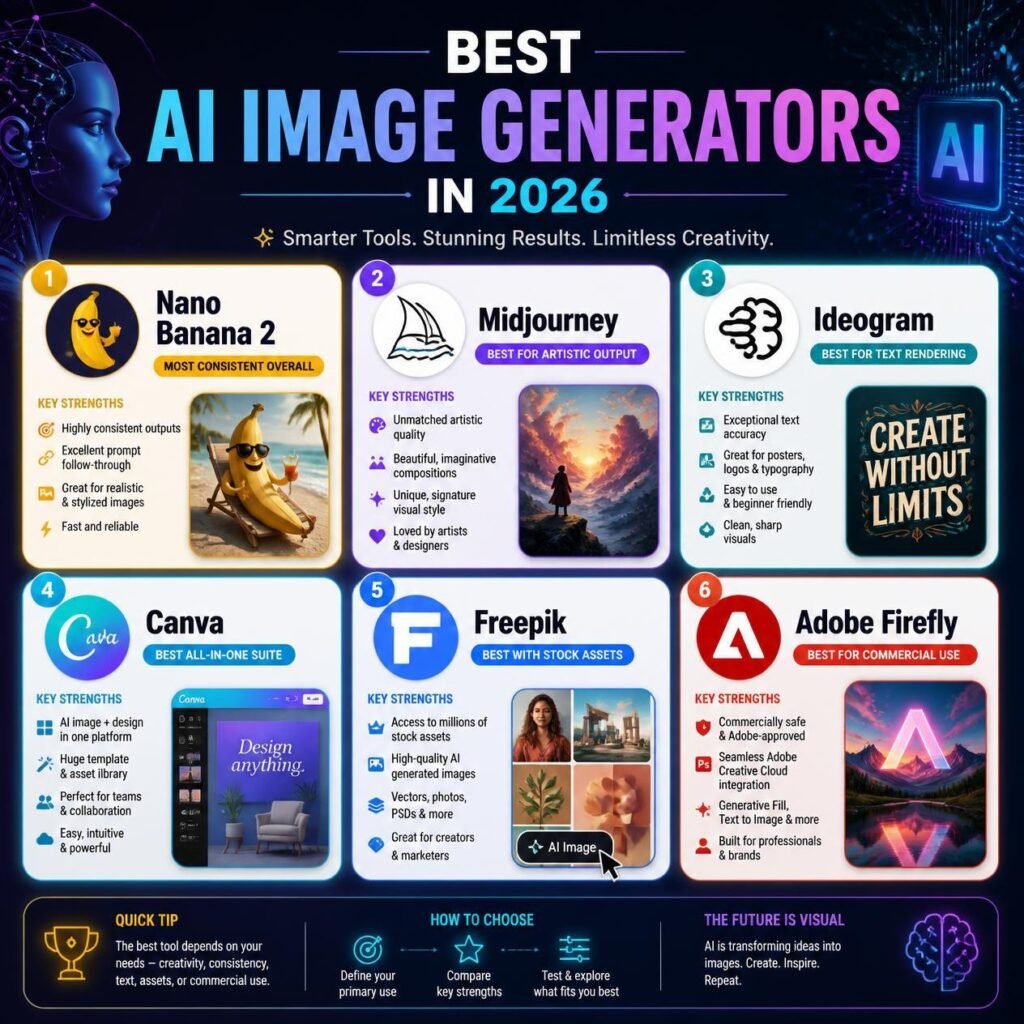
Before chasing anything fancy, I wanted a single model I could trust for almost anything — illustrations, product shots, quick concept tests, all of it. After running the same prompts through nearly a dozen tools, one kept coming out on top. <cite index=”23-1″>Nano Banana 2 was the most consistent performer overall, handling illustration accuracy, coming closest to photorealism, and rendering typography well</cite> — and typography, it turns out, is where most image models quietly fall apart.
That consistency held up across independent testing, too, not just my own trial and error. <cite index=”25-1″>Across repeated tests using the same five prompts, Nano Banana Pro created the most realistic images with sharp detail, and it solved one of the industry’s more stubborn problems: morphing two images together seamlessly.</cite> So, if you only try one tool from this entire list, this is genuinely the one to start with.
Then, I Went Looking for Something More Artistic
Realism is useful, but it isn’t always the point. Sometimes I want an image that looks unmistakably made, with mood and texture a photograph could never fake. That’s where Midjourney still holds its ground. <cite index=”20-1″>It remains the benchmark for aesthetic output in 2026 — if you want art that looks like art, moody and painterly with that specific Midjourney vibe, nothing else quite gets close.</cite>
That said, it isn’t without friction. <cite index=”20-1″>Photorealism isn’t its strongest game, the Discord-based workflow is finally being phased out for a proper web app, and text rendering remains mediocre.</cite> In other words, I reach for Midjourney when the feeling of an image matters more than its literal accuracy — and I reach for something else entirely the moment text needs to appear cleanly inside the frame.
Speaking of Text, That Problem Sent Me Elsewhere
Nothing ruins a good AI image faster than garbled lettering on a sign or a product label that looks like alien script. So when a project actually needed clean, readable text baked into the image itself, I stopped fighting Midjourney and moved to Ideogram instead. <cite index=”27-1″>It’s specifically strong at accurate text rendering in AI images</cite>, which makes it the obvious pick for ads, packaging mockups, or anything where a misspelled word would blow the whole illusion.
Interestingly, Ideogram is also one of the more accessible tools on this list if budget is tight. <cite index=”22-1″>It offers a free plan, though you’re limited to 10 credits a week, have to wait a few minutes for a generation to start, and only get the basic feature set.</cite> Not unlimited, certainly, but enough to test whether it actually solves your specific problem before paying for it.
Meanwhile, Some Jobs Just Needed a Whole Suite
At some point, I got tired of bouncing between five separate websites for five separate jobs — one for images, another for video, a third for basic design work. Canva quietly solved that fatigue simply by being everywhere I already was. <cite index=”19-1″>It’s best for collaborative, all-in-one visual content creation, ideal for teams and creators who want AI image generation alongside design, presentations, and brand collaboration tools in one place.</cite>
Similarly, when a project needed AI visuals and a library of ready-made stock assets to fill in the gaps, Freepik became the more practical choice. <cite index=”19-1″>It offers AI-generated visuals alongside a large collection of vector graphics and templates</cite>, which meant I wasn’t generating an image from scratch for every single graphic on a page — sometimes the stock library just already had what I needed.
For Client Work, Licensing Suddenly Mattered a Lot
Early on, I honestly didn’t think much about usage rights. Then a client asked, directly, whether the visuals I’d generated were safe to use commercially — and I realized I didn’t actually know the answer for half my toolkit. That’s when Adobe Firefly earned a permanent spot in professional projects specifically. <cite index=”19-1″>It’s built for professional-grade image quality and creative control, and it integrates deeply with Adobe Creative Cloud for advanced design workflows</cite>, but more importantly, <cite index=”27-1″>it’s commercially safe for professional and business use</cite> in a way that gave both me and my client actual peace of mind.
Consequently, for any paid client work now, licensing clarity is one of the first things I check — not an afterthought I bolt on at the end.
Eventually, I Learned Not to Pick Just One
Here’s the part that took me the longest to accept: there isn’t a single “winner” in this category, no matter how confidently some lists present one. Instead, <cite index=”24-1″>the best AI image generator in 2026 depends entirely on your use case</cite> — which sounds like a cop-out until you’ve actually felt the difference between using Midjourney for mood and Ideogram for a label that needs to be legible.
Because of that, rather than committing to one app and living with its limits, I eventually moved toward a hub-style approach. <cite index=”23-1″>Some tools are models, and some are platforms — Nano Banana 2, for instance, is a model made by Google, but you can access it inside platforms like Leonardo.ai or Higgsfield without going directly through Google.</cite> Once I understood that distinction, I stopped thinking in terms of “which app do I open” and started thinking in terms of “which model do I need right now,” accessed through whichever platform happened to host it best.
So, Where Should You Actually Begin?
If you’re starting from zero, here’s the order I’d actually recommend, rather than an alphabetical list pretending everything is equal. Start with Nano Banana 2 for your everyday, reliable default. Move to Midjourney the moment a project needs real artistic mood over strict accuracy. Switch to Ideogram whenever text has to render cleanly inside the image. Bring in Canva or Freepik when you need design tools and stock assets alongside generation, not instead of it. And finally, reach for Adobe Firefly the second client work and commercial licensing enter the conversation.
None of these tools replaced the part of creating that actually mattered to me — the idea itself. What they replaced was the years I would have spent learning to draw well enough to get that idea out of my head. That trade, at least for me, was worth every bit of the experimenting it took to figure out which tool does what.