Best AI Productivity Tools in 2026 to Save Time
There’s a specific kind of tired that has nothing to do with how hard you worked. It’s the tired that comes from a day spent entirely on upkeep — replying to emails that didn’t need a reply, sitting through a meeting that could’ve been three sentences, retyping a summary you basically already knew. I used to think that was just what work felt like. Then I actually sat down and tracked where my hours went for a week, and the number embarrassed me: something close to half my day was maintenance, not output.
That audit is really where this whole story starts. Not with a shiny new tool, but with a blunt question: where is my time actually leaking? Once I had an honest answer, the tools stopped being a wishlist and started being a repair kit.
Step One: Find the Leak Before You Buy the Fix
I’ll admit I got this backwards the first time. I collected tools before I understood my problem, and ended up with ten tabs open and no more free time than before. The better approach, and the one I stick to now, is boringly simple: <cite index=”23-1″>audit your time leaks — meetings, emails, data entry — before deciding what to bring in.</cite> The tool should answer a specific leak, not just sound impressive in a demo.
And resist the urge to stack similar tools on top of each other. <cite index=”18-1″>Two AI writing tools don’t make you write twice as fast — one agent plus one specialized tool for your core output covers most needs.</cite> I learned this after paying for two overlapping subscriptions for three months before noticing I only ever opened one of them.
The Inbox: Where My Mornings Used to Disappear
Email was my biggest leak, no contest. I’d open my inbox “for five minutes” and resurface forty minutes later having accomplished nothing that mattered. What actually fixed it wasn’t willpower — it was letting AI draft the first pass.
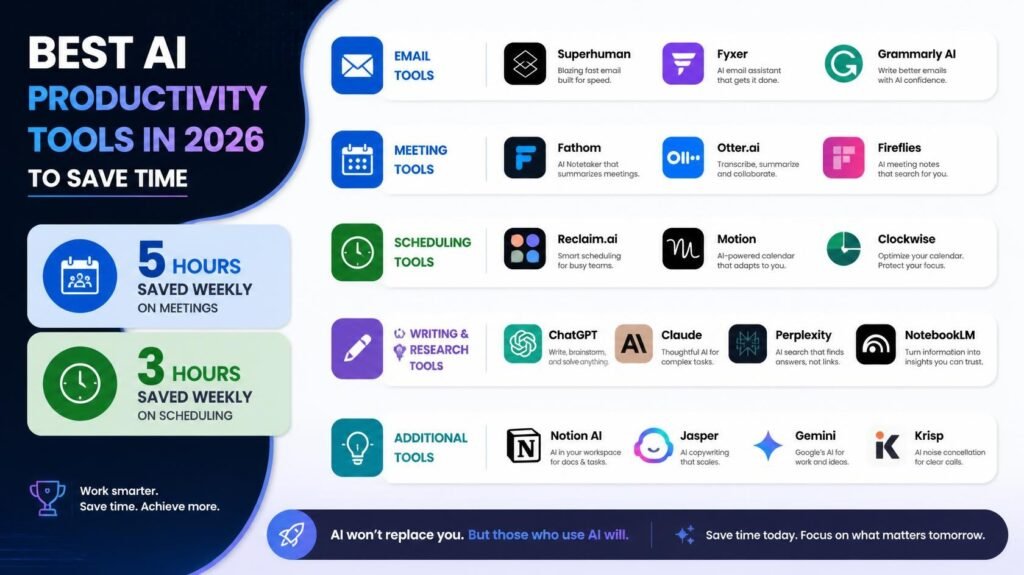
I tried a few tools here before settling in. Superhuman was the first one that made email feel fast again rather than just prettier — <cite index=”18-1″>its time savings on email genuinely compound</cite> the longer you use it, because the shortcuts and triage become muscle memory. Fyxer does something a little different: it runs the inbox almost like a junior assistant, sorting and drafting in the background so I only touch the messages that actually need me. And the newer generation of Grammarly, now closer to an agent than a spellchecker, <cite index=”23-1″>can draft full replies based on your past conversations and calendar availability</cite>, which means the reply is already 80% right before I even open the thread. I still edit everything, but editing a decent draft takes ninety seconds. Writing one from scratch used to take ten minutes and a mild sense of dread.
Meetings: Attending Without Actually Attending
I used to feel guilty about zoning out in meetings that didn’t need me. Now, thanks to Fathom, I don’t attend half of them at all, and I’m not behind on anything. <cite index=”19-1″>It captures every meeting</cite> automatically, and I read the recap in the time it used to take me to find the “join” button.
<cite index=”23-1″>In 2026, attending every meeting is genuinely a choice, not a requirement — AI agents can sit in your place and hand you a tactical summary afterward</cite>, complete with <cite index=”23-1″>real-time transcription and automated action items that sync straight into your project management software.</cite> Otter.ai and Fireflies do this well too, and both plug directly into whatever you’re already using to track work, so nothing gets typed twice.
The other quiet upgrade is that some of these tools are starting to notice things a distracted human might miss. <cite index=”23-1″>A few now offer sentiment analysis of meetings, flagging when a client sounds frustrated or a teammate seems overloaded before anyone actually says it out loud.</cite> I don’t fully trust this yet — it’s a signal, not a verdict — but as an early warning system, it’s saved a couple of relationships I might have let quietly sour.
The measurable win is real, too: <cite index=”25-1″>meeting summarization tools like Otter.ai saved roughly five hours a week</cite> in independent testing, which tracks almost exactly with what I noticed in my own week once I stopped manually writing recap emails after every call.
Scheduling: The Fight I Finally Stopped Having
Calendar tetris used to be its own part-time job — the back-and-forth of “does 2pm work?” repeated four times before anyone actually agreed on a time. Reclaim.ai took that fight away entirely, quietly finding gaps and protecting focus time on my calendar without me having to defend it manually. <cite index=”25-1″>Independent testing put the time saved from automated scheduling with tools like this at roughly three hours a week</cite>, and that number felt almost conservative once I stopped manually shuffling my own calendar every Sunday night. Motion and Clockwise live in the same lane if Reclaim’s particular flavor of automation doesn’t fit your calendar habits.
Writing and Research: Less Blank Page, More Actual Thinking
The blank page is a genuine productivity killer, and it’s the one AI has gotten most obviously good at solving. ChatGPT is still my default first draft machine for almost anything — outlines, emails, brainstorms — because it’s fast and doesn’t need much setup. When something needs to actually hold up under scrutiny, I hand it to Claude instead; <cite index=”19-1″>it’s the engine a lot of serious knowledge workers now run their thinking and writing through</cite>, not just their typing.
For research specifically, I stopped treating “find the sources” as separate from “understand the sources,” and Perplexity is most of the reason why — it hands back cited, current answers instead of confident guesses. NotebookLM does the same job for my own documents: <cite index=”19-1″>it turns a folder of PDFs and notes into something you can actually ask questions of</cite>, and it only answers from what you gave it, so I stopped doubting the answer and re-checking it myself.
The Rest of the Stack Worth Knowing About
A few more tools earned a permanent place even though they don’t fit neatly into one category above. Notion AI is worth it if your team already lives inside Notion — <cite index=”24-1″>the workspace-aware Q&A feature alone saves real time hunting through old docs</cite>, though the value drops fast if Notion isn’t already part of your daily habit. Jasper has quietly become useful beyond marketing copy — <cite index=”23-1″>its brand-voice features now let it ghostwrite emails and reports that sound indistinguishable from your own writing.</cite> Gemini is the natural pick if your whole life already runs through Gmail, Docs, and Sheets — it’s not the sharpest reasoner on this list, but nothing beats it for staying invisible inside tools you’re already using. And Krisp is a small, unglamorous tool that just cancels background noise on calls — easy to forget about until the one meeting where it saves you from explaining a barking dog.
The One Rule That Actually Matters
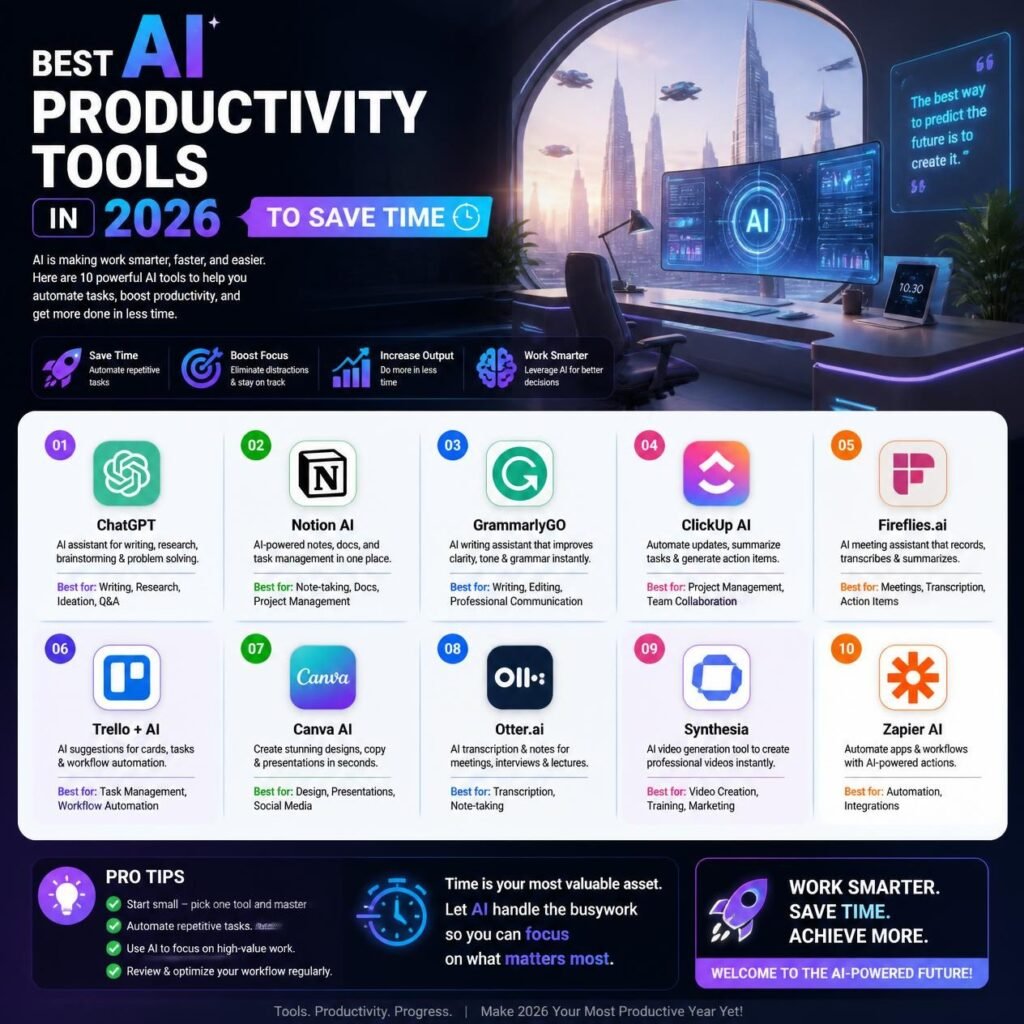
Here’s the thing nobody tells you upfront: more tools is not the goal. <cite index=”18-1″>Start with fewer tools than you think you need. Master one before adding another. Pay for what actually saves you real time. Ignore the rest.</cite> I wasted more hours “optimizing my stack” in early 2026 than I ever saved from the tools themselves, which is a genuinely embarrassing sentence to write but an honest one.
The other trap is subtler: generating so much AI output that editing becomes the new bottleneck. <cite index=”21-1″>A real risk of these tools is losing time feeding prompts and then drowning in the output they produce</cite> — so the skill that actually matters now isn’t prompting, it’s knowing when to stop generating and start cutting.
What I’d Actually Keep If I Had to Start Over
If I stripped my stack down to the absolute essentials — the tools that survived every audit, every “do I really need this” purge — it would look like this:
- Claude or ChatGPT for drafting, thinking, and planning, used daily without ceremony.
- Fathom or Otter.ai for meetings, so nothing depends on my memory.
- Superhuman or Fyxer for the inbox, drafting replies in something close to my own voice.
- Reclaim.ai for scheduling, so I stop relitigating my calendar every week.
- Perplexity or NotebookLM for research, answering from real sources instead of guessing.
That’s it. Five tools, not fifteen. The point was never to use more AI. It was to get an ordinary Tuesday back — the version where the actual work happens before 4 p.m., not the version where you’re still doing upkeep at 7. That’s the only metric that ever mattered to me, and it’s the only one I still check.
Best Free Ai Tools