
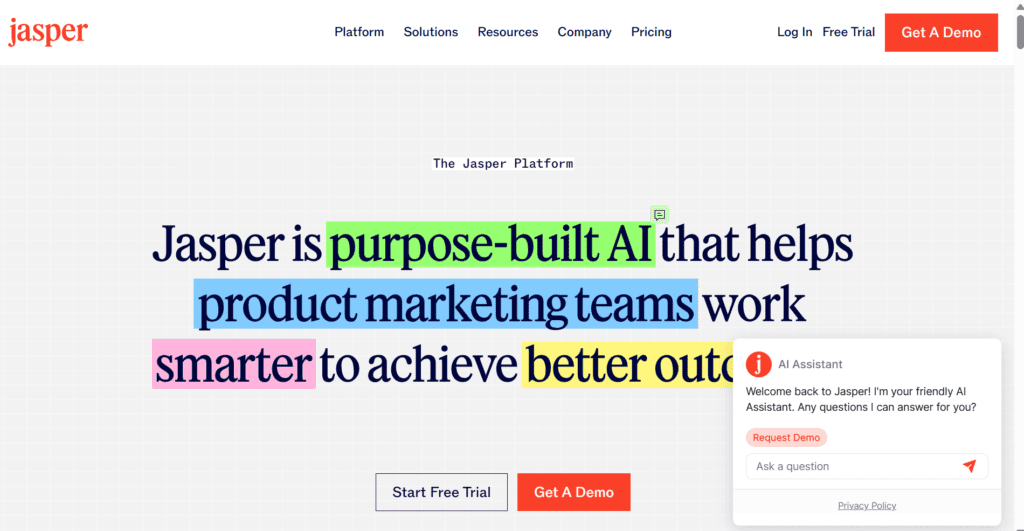
If you create marketing content at scale—blog posts, landing pages, email campaigns, ads, social captions-emphasisesJasper positions itself less as a “fun AI writer” and more as an AI marketing platform focused on brand consistency + workflow speed. Jasper’s messaging today emphasizes “AI Content Automation” powered by Agents, a context layer (often described as “Jasper IQ”), and tools like Jasper Studio and Jasper Grid aimed at moving from strategy execution in one place.
This article breaks down Jasper’s most useful features, real-world advantages, the drawbacks you should expect, and how it compares to common alternatives.
What is Jasper AI?
Jasper is an AI platform designed primarily for marketers and content teams. Instead of only generating text from prompts, Jasper tries to help you maintain a consistent “brand voice,” reuse approved knowledge, and collaborate across campaigns—especially useful when multiple people create content for the same brand.
Key Jasper AI features (what actually matters)
1) Brand Voice (brand consistency at scale)
Jasper’s Brand Voice is one of its most important differentiators: you configure tone/style guidelines so outputs “sound like you,” not like generic AI. This is built to reduce the constant rewriting that happens when multiple writers (or freelancers) contribute content. Jasper+1
Why it matters: If you run a blog or product review site with multiple categories (or you publish for clients), Brand Voice can save a lot of editing time.
2) Knowledge / context assets (stay on-message)
Jasper focuses heavily on using your approved context—brand rules, product info, positioning, audience details—so the AI doesn’t “invent” messaging or drift away from your actual offer. This is part of why it’s often adopted by marketing teams rather than casual creators.
3) Campaign and workflow tools (move faster than prompt-by-prompt)
Jasper highlights tools like Studio and Grid for building repeatable workflows (think: “generate 10 ad angles + 5 email subject lines + landing page outline” as a system, not one-off prompts).
Practical use case: You create one strong “campaign brain,” then repurpose into:
- Blog intro + outline
- Product feature bullets
- Email sequence
- Social posts
4) Templates and marketing-specific outputs
Jasper has long leaned on pre-built templates for marketing tasks (product descriptions, ad copy, feature/benefit bullets, etc.). Jasper even calls out Amazon-style product feature bullets as a common output for brands.
5) Collaboration and team controls
For teams, Jasper’s plan structure and feature set are built around collaboration and multi-user workflows (brand voices, shared assets, etc.). Jasper’s pricing page explicitly positions Business as the option for additional control, security, support, and tailored deployment
Jasper AI pricing (quick overview)
Jasper’s official pricing page currently highlights two primary plans:
- Pro (listed around $69/month monthly or $59/month billed yearly)
- Business (custom pricing)
Jasper also advertises a 7-day free trial for Pro and notes Business plans typically require a longer commitment.
Note: Some third-party breakdowns mention an additional “Creator” tier and per-seat pricing. Always confirm on Jasper’s pricing page before buying because plan names and inclusions can change
Advantages of Jasper AI
1) Better for “brand-safe” marketing than generic chatbots
When you set Brand Voice + knowledge assets, Jasper can produce content that is more consistent across pages and channels than a blank-slate AI tool.
2) Speeds up content production (especially repurposing)
If your workflow is “one core idea → many formats,” Jasper’s marketing workflow orientation can be a real time-saver.
3) Strong user satisfaction in review ecosystems
Jasper maintains a solid presence on review sites like G2 and Capterra, where users commonly praise output quality and usefulness for marketing content (while still acknowledging it needs editing).
4) Clear upgrade path for teams
The Pro/Business split makes sense if you’re moving from solo publishing to a small team and then to a larger org that needs controls and support.
Drawbacks (the real-world issues you should expect)
1) Cost can be high for beginners
Multiple reviews and comparisons repeatedly point out that Jasper is pricey compared to cheaper AI writers—or compared to using a general chatbot for free/low cost.
If you publish 2–4 articles/month, Jasper may feel expensive. If you publish 20+ pieces/month, it’s easier to justify.
2) You still must fact-check and edit
Like other generative AI tools, Jasper can produce content that sounds confident but isn’t fully accurate, especially on niche technical topics or “latest updates.” Reviews frequently flag the need for human editing and verification.
3) Learning curve if you want the best output
Jasper is not hard to use, but to get top results you’ll spend time building:
- Brand voice rules
- Knowledge assets
- Repeatable workflows
That setup cost is worth it for ongoing publishing, but it’s extra work up front.
4) “Generic AI voice” risk if you don’t set guardrails
If you don’t invest in brand voice and context, outputs can still come out generic/repetitive—this is not unique to Jasper, but it’s still a common complaint.
| Tool | Best for | Where it wins | |
| Jasper | Brand-led marketing content | Brand Voice + reusable marketing workflows; team collaboration | Higher cost; still needs editing/fact-checking |
| Copy.ai | GTM/sales + copy workflows | Good for sales/ops style automations and workflows | Brand control differs by setup; some prefer Jasper’s editor/controls |
| Writesonic | Content + templates at competitive pricing | Often praised for template variety; comparisons note strong feature set | Some comparisons still rate Jasper as easier/more flexible for control |
| Grammarly | Editing + correctness | Polishing, grammar, tone tweaks | Not a full campaign/content generation platform (more editing than creation) |
| ChatGPT (general) | Anything + brainstorming | Flexible, great value, fast iteration | You must build your own brand system; consistency can be manual (no “brand platform” by default) |
A useful pattern:
- If you’re doing serious marketing production and want consistent voice across many pages: Jasper tends to make sense.
- If you’re cost-sensitive and want templates: Writesonic is commonly compared as a value option. Zapier+1
- If you want a broader “sales/GTM automation” angle: many teams consider Copy.ai
Who should use Jasper AI?
Jasper is a strong fit if you:
- Publish high volume content (affiliate sites, product reviews, SEO clusters)
- Need consistent tone across categories and writers
- Want to repurpose one campaign into many formats
- Have a small team (or plan to scale)
Jasper is not ideal if you:
- Only need occasional writing help
- Prefer a cheaper “one chatbot does everything” approach
- Need guaranteed factual accuracy without manual checking
Best practices to get better results from Jasper (quick tips)
- Build Brand Voice early (even if basic).
- Create a few knowledge assets: product specs, review scoring rules, “dos/don’ts,” affiliate disclaimers.
- Use Jasper for structure + drafts, then add your “human layer”: real examples, personal testing notes, screenshots, unique comparisons.
- Always fact-check claims, pricing, release dates, and specs.
Conclusion: Is Jasper AI worth it in 2025?
Jasper is worth considering if your goal is marketing content production with brand consistency, not just “generate an article.” Its strengths show up when you publish repeatedly, reuse workflows, and care about outputs sounding like a real brand voice.
But it’s not magic. Expect to edit, verify facts, and spend some time setting up brand context. If you’re early-stage or publishing only a few posts per month, you may get more value from a cheaper tool—or a general chatbot—until your content volume justifies Jasper’s cost.
FAQ
Usefull Links : https://www.jasper.ai/platform
Related Links:

PLEASE SHARE