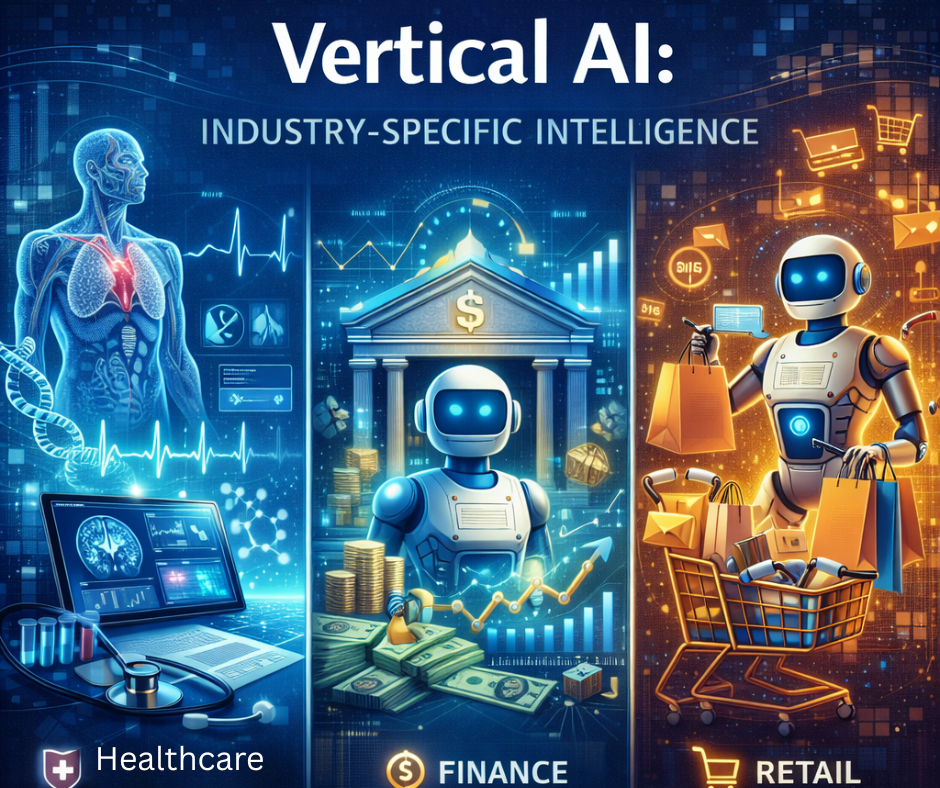

There’s a fascinating pattern emerging in the AI landscape that most people outside the industry haven’t noticed yet. While tech giants battle over who has the most powerful general-purpose AI model, a quieter revolution is happening in the trenches of specific industries. It’s called vertical AI, and it’s about to change how entire sectors operate.
Here’s the core insight: a general AI that knows a little about everything is often less valuable than a specialized AI that knows a lot about one thing. And in industries like healthcare, finance, and retail—where mistakes are costly, regulations are strict, and domain expertise is everything—that specialized knowledge makes all the difference.
Why Vertical AI Matters Now
Think about it this way. If you asked a brilliant generalist doctor and a seasoned cardiologist to diagnose a complex heart condition, who would you trust more? The cardiologist, obviously. They’ve seen thousands of cases, understand the nuances, know which symptoms matter and which are red herrings.
The same logic applies to AI. A general language model can give you decent advice about retail inventory management, but a vertical AI built specifically for retail trained on years of sales data, seasonal patterns, supply chain dynamics, and consumer behaviour, will run circles around it.
This isn’t just theoretical. We’re seeing vertical AI solutions dramatically outperform general-purpose alternatives in real-world applications. They understand industry jargon, comply with sector-specific regulations, integrate with existing workflows, and deliver results that matter to the people actually doing the work.
The timing is perfect too. General AI models have reached a level of sophistication where they can serve as powerful foundations. But the low-hanging fruit in AI-chat, summarization, general question-answering—is getting crowded. The real value is moving to specialized applications that solve specific, high-stakes problems.
Healthcare: Where Precision Meets Privacy

Healthcare might be the most compelling case for vertical AI, and for good reason. The domain is incredibly complex, heavily regulated, and the stakes literally involve life and death. You can’t just plug in ChatGPT and call it a day.
Consider medical imaging. A vertical AI system for radiology isn’t just looking at X-rays or MRIs-it understands anatomy, pathology, and the subtle patterns that distinguish benign from malignant. It knows that certain findings require immediate attention while others can wait. It speaks the language of radiologists and integrates with PACS systems that hospitals actually use.
But it goes deeper than that. Healthcare vertical AI must navigate HIPAA compliance, understand medical coding standards like ICD-10, and work within clinical workflows that have evolved over decades. A general AI has no clue about these constraints. A vertical healthcare AI is built around them from day one.
We’re seeing impressive applications emerge. AI systems that can analyze patient records and flag potential drug interactions before they become problems. Diagnostic assistants that help rural doctors access specialist-level insights. Administrative AI that handles the nightmare of insurance preauthorization, freeing up staff to actually care for patients.
The really interesting development is in personalized medicine. Vertical AI systems can analyze genomic data, medical history, lifestyle factors, and current research to suggest treatment plans tailored to individual patients. This isn’t something a general AI could do reliably-it requires deep domain knowledge about genetics, pharmacology, and clinical medicine.
Privacy is another crucial dimension. Healthcare vertical AI can be deployed on-premises or in private clouds, keeping sensitive patient data within the security perimeter that regulations demand. General cloud-based AI services often can’t offer these guarantees.
Finance: Where Accuracy Is Everything
If healthcare is about life and death, finance is about risk and reward-and the tolerance for error is equally low. A general AI that hallucinates a fact might be amusing in a casual conversation. In finance, it could trigger regulatory violations, trading losses, or compliance disasters.
This is why financial institutions are investing heavily in vertical AI rather than relying on general-purpose models. These systems understand financial instruments, market dynamics, regulatory frameworks, and the specific language of finance.
Take fraud detection, which has evolved far beyond simple rule-based systems. Modern vertical AI for fraud doesn’t just flag suspicious transactions-it understands context. It knows that a $5,000 wire transfer might be perfectly normal for a business account but highly suspicious for a college student. It recognizes patterns across millions of transactions while adapting to new fraud techniques in real-time.
Credit risk assessment is another area where vertical AI shines. These systems analyze traditional credit data alongside alternative signals—cash flow patterns, business relationships, market conditions—to make nuanced lending decisions. They’re trained on historical loan performance data specific to the institution, understanding which factors actually predict default in that particular portfolio.
Then there’s algorithmic trading, where vertical AI systems process market data, news feeds, and economic indicators to make split-second decisions. These aren’t general AIs dabbling in finance-they’re specialized systems built by teams of quantitative analysts who understand both AI and market microstructure.
Compliance is perhaps where vertical AI provides the most immediate value. Financial regulations are complex, constantly changing, and vary by jurisdiction. Vertical AI systems can monitor communications, transactions, and activities for potential compliance issues, understanding the nuanced language of regulations like MiFID II, Dodd-Frank, or Basel III. A general AI would struggle to keep pace with this complexity.
Retail: Connecting Consumers and Commerce
Retail might seem less critical than healthcare or finance, but the commercial stakes are enormous, and the competitive advantages from vertical AI are real and measurable.
The modern retail environment generates massive amounts of data—every click, purchase, return, search, and abandon. General AI can analyze this data, but vertical retail AI understands what it means in the context of consumer behavior, seasonality, inventory management, and profitability.
Take demand forecasting. A vertical retail AI doesn’t just predict what products people will buy—it understands fashion cycles, weather impacts, local demographics, promotional effects, and competitor actions. It knows that umbrella sales spike before storms, not during them. It recognizes that certain products are complementary and should be stocked together.
Dynamic pricing is another killer application. Vertical AI systems can adjust prices in real-time based on inventory levels, competitor pricing, demand signals, and margin targets. They understand the psychology of pricing—when to discount, how much, and which products to use as loss leaders. This requires deep retail domain knowledge that general AI simply doesn’t possess.
Personalization in retail goes way beyond “customers who bought this also bought that.” Vertical AI systems build rich customer profiles, understand purchase intent from browsing behavior, and can predict lifetime value. They know how to balance immediate conversion with long-term customer relationships.
Supply chain optimization is where vertical retail AI really flexes. These systems coordinate inventory across warehouses and stores, optimize shipping routes, predict stockouts before they happen, and balance holding costs against lost sales. They understand the specific constraints of retail logistics-shelf life for perishables, seasonal storage limitations, last-mile delivery economics.
Then there’s the emerging frontier of conversational commerce. Vertical retail AI can handle customer service inquiries with deep product knowledge, process returns understanding store policies, and make recommendations based on the customer’s purchase history and preferences. These aren’t generic chatbots-they’re shopping assistants with real expertise.
The Pattern Across Industries
Looking across healthcare, finance, and retail, a clear pattern emerges. Vertical AI succeeds where:
Domain expertise is critical. General knowledge isn’t enough—you need deep understanding of industry-specific concepts, terminology, and practices.
Regulations are strict. Industries with heavy compliance requirements need AI systems built with those constraints baked in, not bolted on.
Integration matters. Vertical AI works with existing industry-standard tools, data formats, and workflows rather than requiring wholesale system changes.
Stakes are high. When errors are costly—financially, medically, or reputationally—specialized AI that reduces risk is worth the investment.
Data has industry-specific structure. Medical records, financial transactions, and retail purchases each have unique patterns that vertical AI is trained to recognize.
The Road Ahead
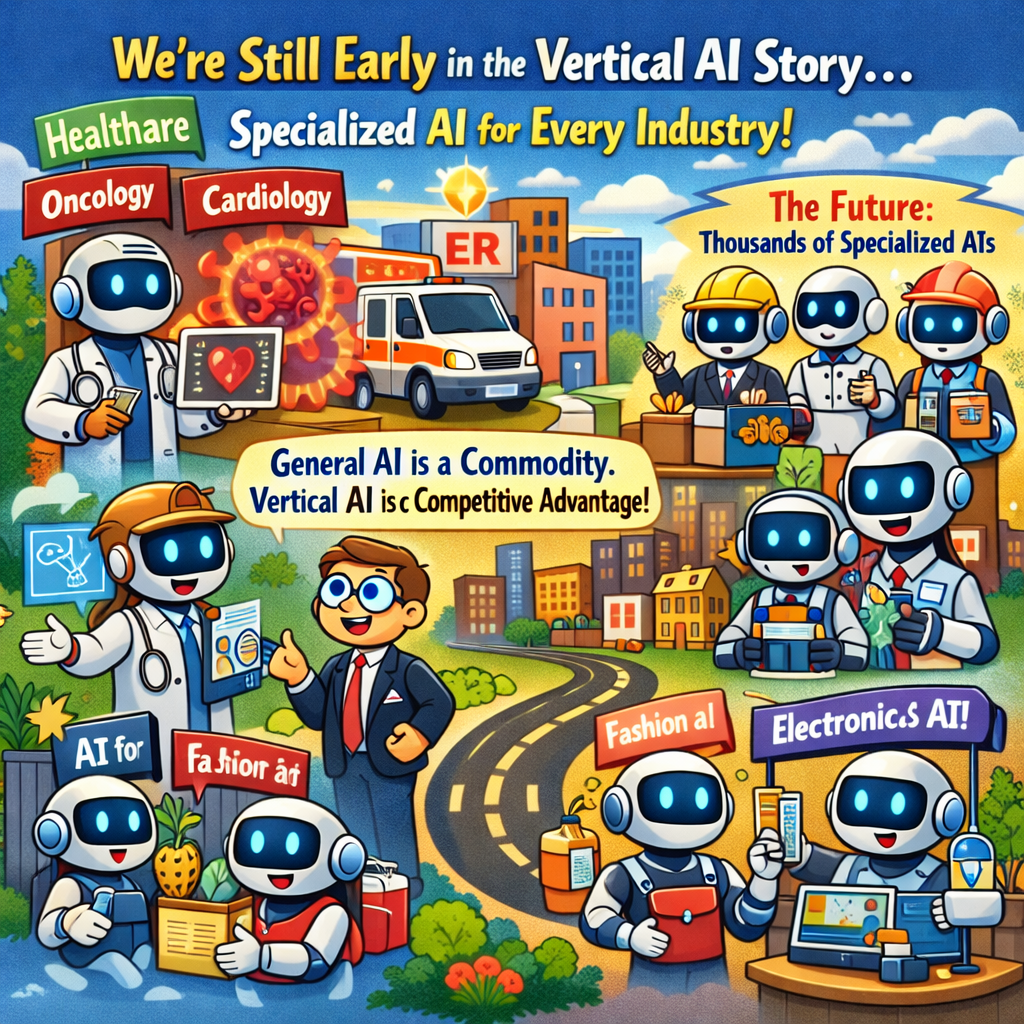
We’re still early in the vertical AI story. Most industries are just beginning to explore what’s possible when AI is built specifically for their needs rather than adapted from general-purpose models.
The next wave will likely see even narrower specialization-vertical AI not just for healthcare, but for oncology, cardiology, or emergency medicine. Not just for retail, but for grocery, fashion, or electronics. The more specific the domain, the more valuable deep expertise becomes.
For businesses, the message is clear: general AI is a commodity, but vertical AI is a competitive advantage. The companies that win will be those that invest in building or adopting AI systems that truly understand their industry, not just ones that happen to work in it.
The future of AI isn’t one model to rule them all. It’s thousands of specialized intelligences, each an expert in its domain, working alongside humans who need real expertise, not just clever conversation.