
The Year I Stopped Paying for Everything: Best Free AI Tools in 2026 for Work, Study, and Business
It’s 2 a.m. on a Tuesday, and I’m staring at a half-finished slide deck, a spreadsheet full of half-true numbers, and a to-do list that’s grown three new items since dinner. Sound familiar? A year ago, my solution to this kind of chaos was simple: throw money at it. Subscribe to another app, upgrade another plan, hope the credit card statement wouldn’t sting too much at the end of the month.
Somewhere in 2026, that changed. Not because I got richer — quite the opposite — but because the free tiers of AI tools finally became good enough to actually finish the job, not just tease you into paying. This isn’t a spec sheet. It’s the story of how a cluttered, over-subscribed workflow became a lean one, tool by tool, mistake by mistake.
The Chatbot That Became a Coworker
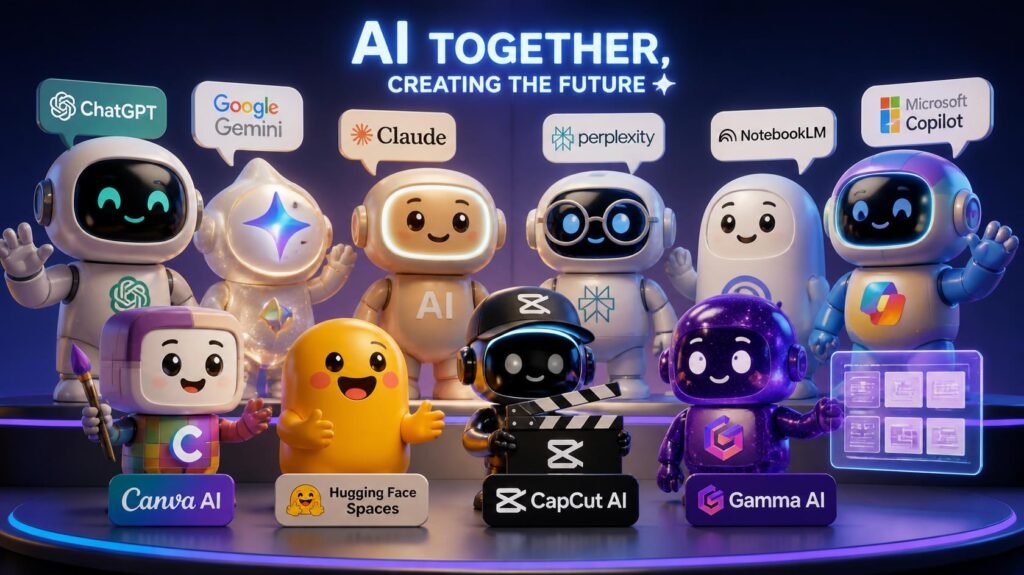
I started, like most people did, with a general-purpose chatbot. The honest truth is that in 2026 you don’t have to pick just one. Some of the best free AI tools available in 2026 include ChatGPT, Google Gemini, Claude AI, Perplexity AI, NotebookLM, Microsoft Copilot, Canva AI, Hugging Face Spaces, CapCut AI, and Gamma AI.
I use two of them side by side now, almost like consulting two coworkers with different strengths. <cite index=”6-1″>ChatGPT or Gemini works well for everyday help, while Claude tends to be the one I reach for when the writing or reasoning actually has to hold up under scrutiny.</cite> There’s a rhythm to it: quick first drafts and brainstorming go to one, anything that needs careful structure or nuance goes to the other. Neither costs a cent to start.
The catch, and there’s always a catch with “free,” is patience. <cite index=”2-1″>The free ChatGPT plan gives you roughly ten messages every five hours</cite> — plenty for drafting an email between meetings, not enough if you’re trying to write a whole report in one sitting. I learned this the hard way during a deadline crunch, watching a usage limit pop up mid-sentence like a rude interruption. The fix wasn’t paying up. It was pacing myself, and keeping a second tool open for when the first one needed a breather.
Research Stopped Feeling Like Guesswork
The tool that genuinely changed how I work, though, wasn’t a chatbot at all. It was NotebookLM. I’d been burned before by AI that confidently made things up, so I was skeptical. Then I fed it a stack of PDFs from a client project — contracts, old reports, a tangle of meeting notes — and asked it questions.
<cite index=”3-1″>Unlike a standard chatbot, it lets you upload your own sources and builds a grounded AI expert on only that material, so its answers stay tied to what you gave it.</cite> No more chasing down a “fact” that turned out to be a hallucination. Every answer pointed back to the actual document. And the free tier isn’t a stingy trial version, either — <cite index=”3-1″>you can create up to 100 notebooks, each holding 50 sources, with up to 500,000 words per source.</cite>
For students, this is close to a superpower. <cite index=”3-1″>It can turn a dense methodology paper into a study guide, a set of flashcards, or an audio-podcast-style discussion between two AI hosts, handy for auditory learners.</cite> I tested this on a genuinely brutal academic paper about supply chain modeling, mostly out of curiosity, and ended up listening to the “podcast” version on a walk instead of rereading it for the third time. It’s a small thing, but it’s the kind of small thing that saves an evening.
One honest caveat worth carrying with you: <cite index=”5-1″>NotebookLM is currently free during its preview period, and it’s worth keeping an eye on how that pricing evolves.</cite> Nothing free stays free forever by accident — it stays free because someone’s still deciding how to charge for it later.
Design, Without the Design Degree
I’ve never been able to draw a straight line, let alone design a slide deck that doesn’t look like it was built in 2009. Canva’s AI features quietly fixed that. It’s become the default answer whenever a task needs to look like something, not just say something — <cite index=”6-1″>use Canva when design is the bottleneck, the same way you’d reach for ChatGPT or Gemini for everyday tasks.</cite>
And when the deliverable is a presentation rather than a static graphic, Gamma has become my quiet favorite. <cite index=”1-1″>It converts notes into presentations, documents, and webpages</cite> almost instantly — I’ve turned a messy bullet-point outline into a client-ready deck in the time it used to take me to just format the title slide.
The Writing Got Cleaner, Without Losing My Voice
I was worried, early on, that leaning on AI for writing would flatten everything into the same bland, corporate tone. What actually happened was subtler. <cite index=”6-1″>Claude became the tool I trust for careful writing and reasoning</cite>, but I still write the first draft myself — it’s better at tightening what’s already there than inventing my voice from nothing. Grammarly sits quietly in the background the whole time, catching the small stuff so I don’t have to think about it.
Coding, for Someone Who Barely Codes
I’m not a developer. But every few months some project needs a script, a small automation, a website tweak — and I used to either pay a freelancer or give up. Cursor changed that math. <cite index=”7-1″>Its free tier includes 2,000 code completions and 50 premium model requests per month, and because it’s a full VS Code fork, you get a familiar editor with AI built directly into the workflow — inline edits, chat, codebase-aware suggestions.</cite>
It’s not going to replace an engineering team. But <cite index=”7-1″>for hobby projects and learning, the free tier is generous enough to actually be useful</cite>, and that’s exactly the bar I needed cleared. GitHub Copilot sits in the same lane — <cite index=”7-1″>its free tier offers 2,000 code completions and 50 chat messages a month across VS Code, JetBrains, and Neovim, including Copilot Chat for explaining code, generating tests, and debugging.</cite> Students and open-source maintainers get even more for nothing at all.
Where the Free Ride Actually Ends
I want to be honest about the parts that didn’t work out, because every “top tools” list I read this year skipped this part.
Website builders are the clearest example. I tried spinning up a landing page for a side project using a free AI builder, and it looked genuinely decent — for about ten minutes, until I tried to connect a real domain. <cite index=”6-1″>Free site builders are useful for testing ideas, not usually for launching a serious business site — connecting custom domains, collecting payments, or accessing additional features almost always requires a paid plan.</cite> Use them to test your messaging and layout, not to actually launch.
Meeting tools have a similar shape. Fathom, for instance, is genuinely useful — <cite index=”1-1″>it records meetings and creates summaries and action items</cite> — but like most tools in this category, the free tier is built to show you the value, and the deeper features live behind a paywall.
What I’d Actually Tell a Friend
If someone asked me to start from scratch tomorrow, with zero budget, here’s roughly what I’d tell them:
- For everyday thinking and writing: ChatGPT or Gemini for volume, Claude when the writing needs to actually hold up.
- For research and studying: NotebookLM, without hesitation — the “grounded in your own sources” thing is not marketing fluff.
- For anything visual: Canva for graphics, Gamma for decks and documents.
- For polish: Grammarly, running quietly in the background.
- For a little bit of code: Cursor or GitHub Copilot, especially if you’re a student.
None of this is a permanent setup. <cite index=”6-1″>The real trick is using the free stack to find your actual bottleneck before you spend any money — if you’re hitting daily limits on one tool, that tells you exactly where to invest first, and only there.</cite> I still don’t pay for most of what I use. But I finally know, with some precision, what I would pay for if I had to. That clarity, oddly enough, might be the most valuable thing a year of free AI tools gave me.
Use full links: